Introduction
Airports are among the most operationally complex security environments on earth. Every day, they must process hundreds of thousands of passengers accurately, quickly, and without creating conditions that increase security risk. Traditional document-based identity verification, reliant on human inspection of passports and boarding passes, introduces well-documented vulnerabilities: officer fatigue, document forgery, inconsistent screening quality, and throughput constraints that create bottlenecks at peak hours.
Facial recognition technology has moved from proof-of-concept to operational infrastructure at airports across every major region. For government agencies, border control authorities, and airport security leaders, it is no longer a question of whether to deploy biometric identity verification but how to do it correctly, within legal frameworks, and at scale.
This article examines how facial recognition works in airport environments, where it has been successfully deployed, what the genuine operational benefits and challenges are, and what regulatory obligations now shape every deployment decision.
How Facial Recognition Works in Airport Environments
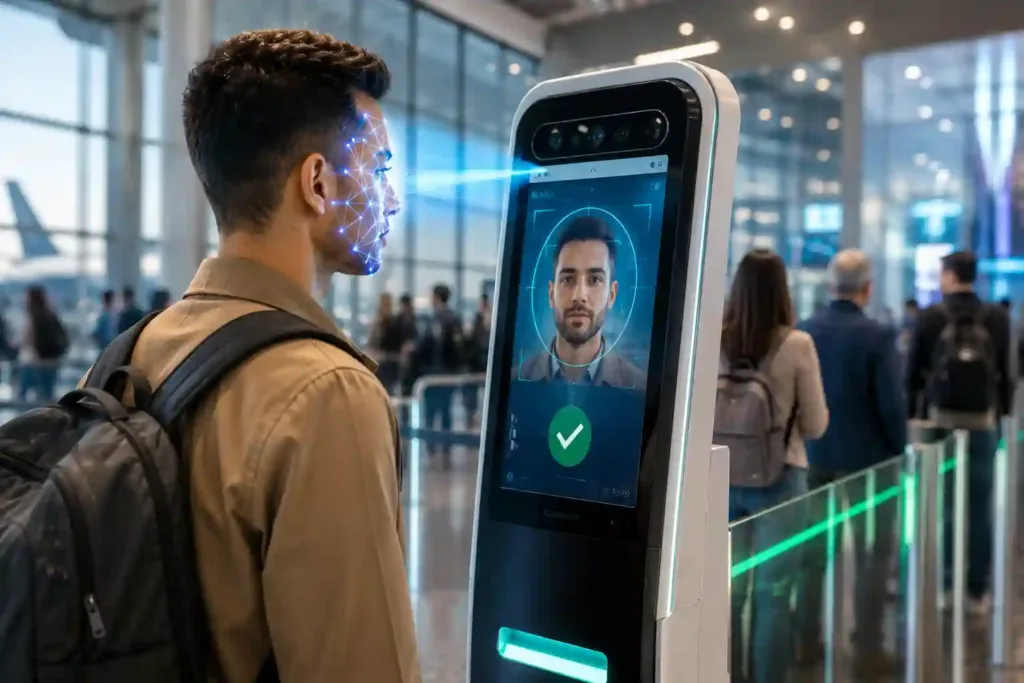
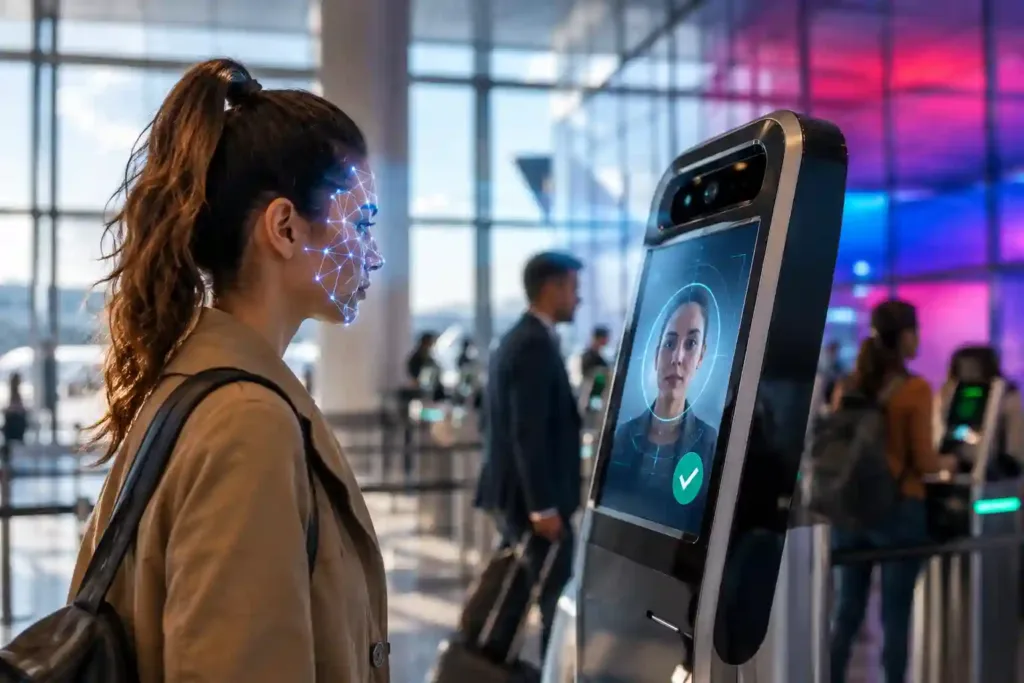
Facial recognition in airports is not a single technology. It is a pipeline that combines image capture, algorithmic processing, database matching, and identity validation. Understanding the architecture matters, because the operational risks and accuracy limitations differ at each stage.
The system typically begins with a high-resolution camera capturing a live image of a passenger. That image is processed to extract a facial template, a mathematical representation of the geometric relationships between facial landmarks: the distance between the eyes, the shape of the jawline, and the contour of the nose. This template is then compared against a reference image.
One-to-One Verification vs. One-to-Many Identification
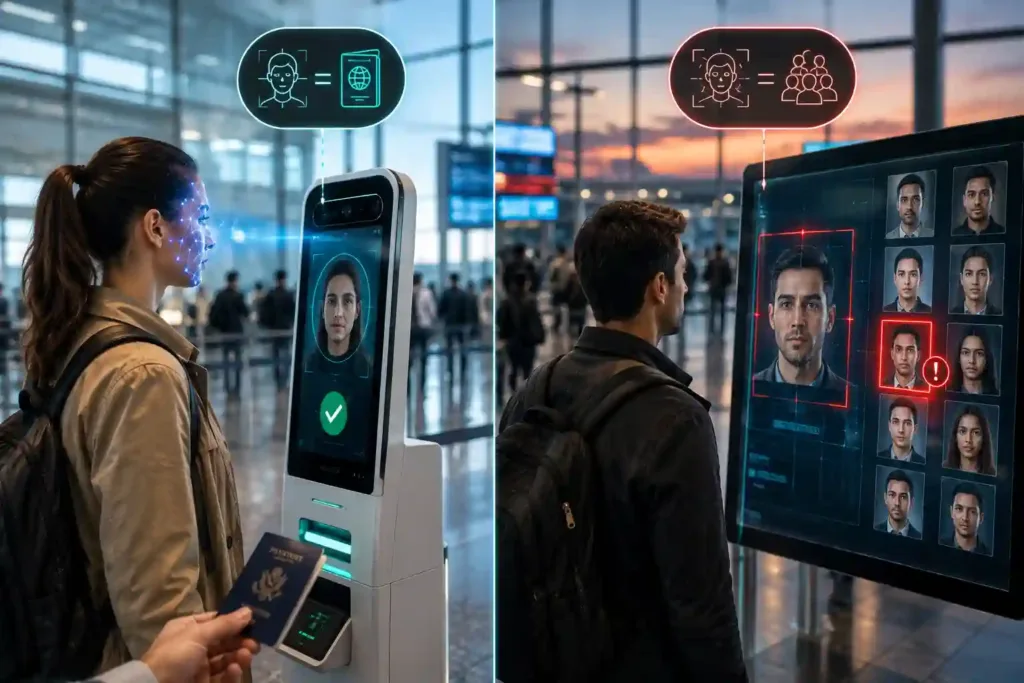
These are fundamentally different operations, and conflating them leads to poor policy decisions.
One-to-one verification (also called 1:1 matching) confirms that the person standing at the checkpoint is the same person shown in a reference document, typically a passport, visa, or boarding pass. This is the primary mode used at airport e-gates and automated border control systems. It is faster, more accurate, and less legally contentious than identification.
One-to-many identification (1:N matching) compares a live facial image against a large database to determine who someone is or whether they appear on a watchlist. This is the mode used by law enforcement and border security for threat detection. It is computationally more demanding, carries a higher false positive risk at scale, and is subject to significantly more stringent regulatory oversight.
Airport deployments typically use both, depending on the checkpoint. E-gates at immigration use 1:1 verification. Security screening systems connected to national watchlists use 1:N identification.
Liveness Detection and Anti-Spoofing
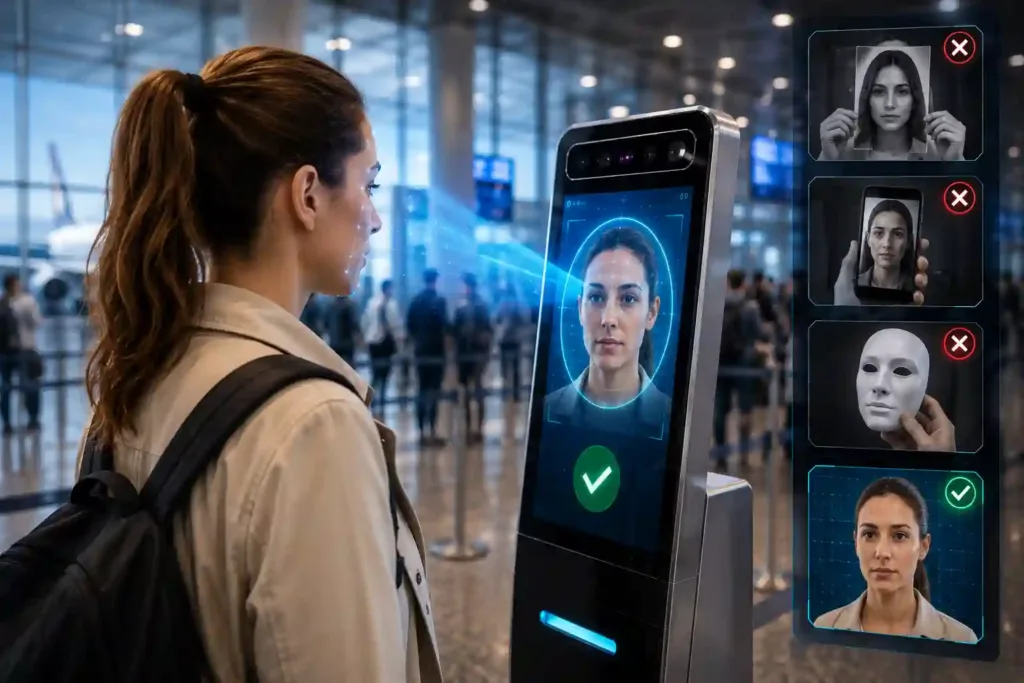
A critical but frequently underreported component of airport biometric systems is liveness detection, the capability that prevents the system from being fooled by a photograph, a video replay, or a 3D-printed mask.
Modern liveness detection uses a combination of passive techniques (analysing skin texture, micro-movements, and depth cues from a single image) and active techniques (prompting a passenger to blink or turn their head). Leading systems now use infrared imaging and 3D depth mapping to distinguish a live face from a flat image.
Without robust liveness detection, the accuracy of the facial recognition system is largely irrelevant from a security standpoint.
Global Deployment Landscape in 2026
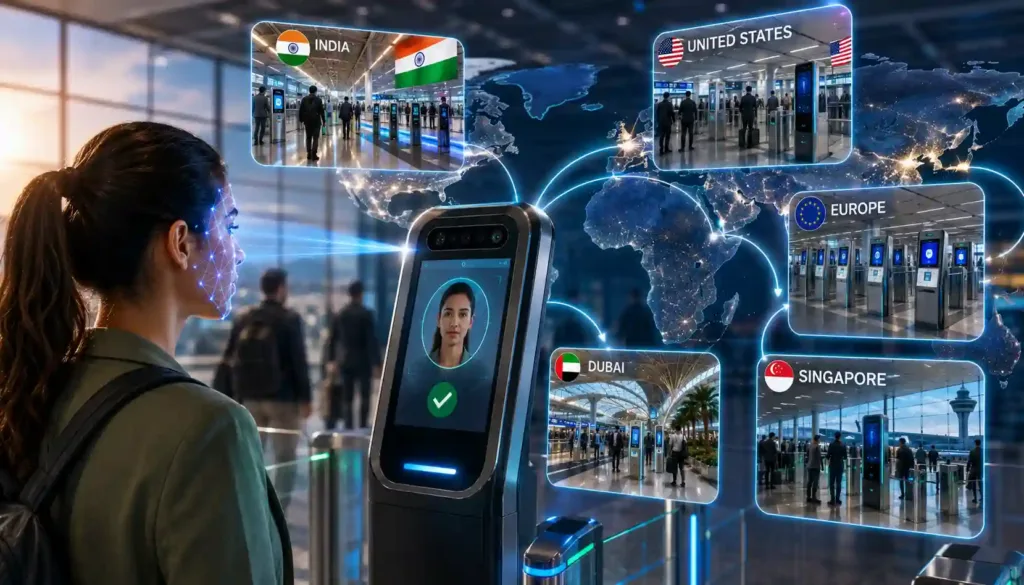
Facial recognition at airports is now mainstream infrastructure, not an experimental programme. Deployments span commercial aviation hubs, military airbases, and land border crossings.
India: DIGI YATRA
India’s DIGI YATRA programme is one of the most ambitious national-scale airport biometric deployments in the world. Originally piloted at select airports in 2022, the programme has expanded to cover a significant portion of major Indian airports, allowing passengers to use facial recognition for seamless entry and boarding without repeatedly presenting physical documents.
The system links a passenger’s boarding pass data to their facial biometric at enrolment, and each subsequent checkpoint verifies identity against that linked record. The Central Identity Data Repository (CIDR) and DigiLocker integration provide the underlying identity infrastructure.
For airport operators and government planners evaluating scalable biometric deployments, DIGI YATRA offers a useful reference architecture: it demonstrates how a national-level programme can be implemented across multiple airport operators while maintaining a consistent passenger experience and data governance framework.
United States: CBP Biometric Entry-Exit
US Customs and Border Protection’s Biometric Entry-Exit programme deploys facial recognition at air entry and exit points across the country. The programme compares arriving and departing passenger images against photos from passports, visas, and other travel documents held in government databases.
CBP has reported significant reductions in processing time at major international airports, with biometric lanes consistently outperforming document-based lanes on throughput. The programme also operates in partnership with commercial airlines, several of which have integrated facial boarding at departure gates.
The operational logic is clear: for a border agency processing millions of international arrivals each year, even marginal gains in per-passenger processing time translate to substantial reductions in queuing, officer workload, and infrastructure cost.
Europe: e-Gates and the Entry-Exit System
European airports have operated biometric e-gates at immigration for over a decade. The EU’s Entry-Exit System (EES), which records biometric data including facial images of non-EU nationals crossing Schengen external borders, represents a significant expansion of biometric data collection and retention at the border.
Airports including Heathrow, Schiphol, and Frankfurt operate extensive e-gate infrastructure. The UK’s ePassport gates use facial recognition to match a passenger’s live face to the chip image in their biometric passport, processing arrivals faster than staffed desks with consistently high accuracy.
Middle East and Asia-Pacific
Dubai International Airport has been among the most aggressive early adopters of biometric identity verification globally, with facial recognition integrated into smart gates across its terminals. Singapore’s Changi Airport has similarly embedded biometrics into its passenger journey from check-in through departure.
These deployments are notable not just for their scale but for their integration philosophy: rather than adding facial recognition as a standalone checkpoint, they have embedded it as the primary identity mechanism across the entire passenger journey.
Operational Benefits for Airport Authorities and Border Agencies
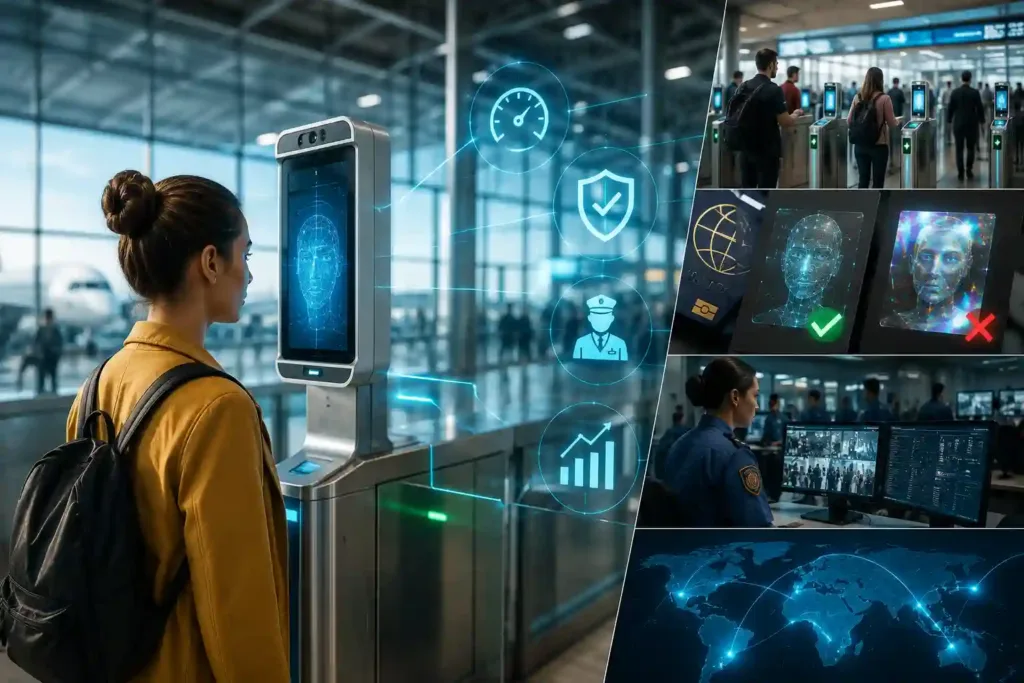
The practical case for facial recognition at airports rests on four operational pillars.
Processing speed: Biometric e-gates process passengers significantly faster than staffed immigration desks. For large hub airports operating at capacity, this directly reduces terminal congestion and improves passenger experience. At peak periods, the ability to sustain throughput without degradation is operationally valuable.
Reduced document fraud exposure: Physical document inspection is vulnerable to high-quality forgeries and identity substitution. Facial recognition, when linked to cryptographically secured chip data in biometric passports, is substantially more resistant to document fraud than human inspection alone.
Officer reallocation: When routine identity verification is automated, border control officers can be redeployed to higher-value screening tasks: behavioural analysis, secondary screening, intelligence-led operations, and exception handling. The technology does not replace officers; it changes what they spend their time on.
Audit trail and accountability: Every biometric transaction generates a timestamped record. This creates an audit-quality log of border crossings that supports post-event investigation, supports asylum and immigration proceedings, and enables detection of individuals who have overstayed their permitted travel period.
Integration with Watchlists, National Databases, and INTERPOL
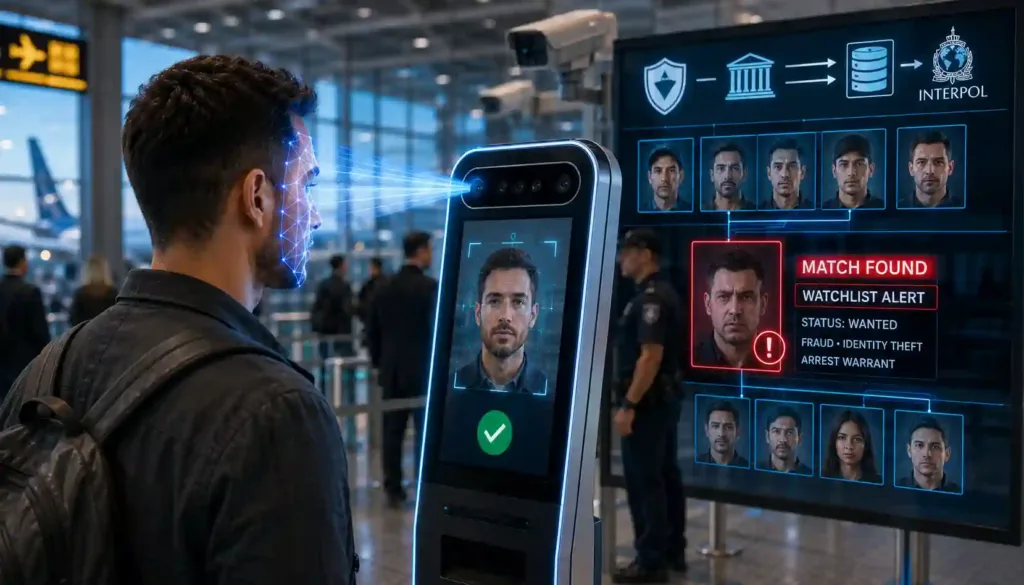
For law enforcement and national security agencies, the most operationally significant capability is not passenger processing speed but the ability to identify persons of interest in real time at the border.
When facial recognition systems at airports are integrated with national watchlists, law enforcement databases, and international systems such as INTERPOL’s facial recognition database, the airport becomes a high-confidence detection point. Individuals subject to arrest warrants, travel bans, or security watch-listing can be flagged at the moment of arrival without relying on document-based name matching, which is vulnerable to aliases and document substitution.
Accuracy, Bias, and the Reliability Question
Facial recognition accuracy is not a single number. It varies by algorithm, hardware, demographic group, lighting conditions, image quality, and the matching threshold set by the operator.
The relevant accuracy metrics for airport deployments are:
False Acceptance Rate (FAR)
The rate at which the system incorrectly accepts an impostor as a genuine match. In a security context, this is the critical failure mode.
False Rejection Rate (FRR)
The rate at which the system incorrectly rejects a genuine match. In an airport context, this creates passenger friction and delays.
These two rates are in tension. Lowering the matching threshold reduces FAR but increases FRR. Raising it does the reverse. The operator must make an explicit, documented decision about where to set this threshold, balancing security risk against passenger experience.
Demographic performance gaps remain a genuine concern
Research published by institutions including NIST (National Institute of Standards and Technology) has found that some facial recognition algorithms perform less accurately across demographic groups, with documented performance differences across skin tone and age categories. Airport operators and government agencies deploying these systems have an obligation to test performance across the demographic profile of the populations they process and to document those test results.
Cybersecurity Risks in Biometric Infrastructure

Biometric data is uniquely sensitive. Unlike a password or a PIN, a facial template cannot be revoked and reissued if it is compromised. An individual has exactly one face. The cybersecurity implications of this irreversibility are significant and need to be addressed explicitly in the system architecture, not treated as an afterthought.
Airport biometric systems are high-value targets. They hold large volumes of sensitive personal data, are connected to national identity infrastructure, and operate in environments with complex supply chains involving multiple technology vendors and system integrators.
The key cybersecurity risks include:
Data breach of stored facial templates
If the biometric database is compromised, affected individuals cannot simply change their biometric. Mitigation requires strong encryption of stored templates, minimising the duration of storage, and where possible, storing cancelable biometric representations rather than raw templates.
Man-in-the-middle attacks on the verification pipeline
Intercepting and substituting the facial image or template during the matching process is a theoretical attack vector that needs to be addressed in the communication security architecture of the system.
Supply chain vulnerabilities
Airport biometric systems involve hardware vendors, software vendors, system integrators, and connectivity infrastructure. Each interface is a potential attack surface.
Insider threat
Operational staff with access to biometric databases or system configurations represent a risk that technical controls alone cannot fully mitigate. Access controls, audit logging, and personnel security measures are necessary complements to technical safeguards.
Conclusion
Facial recognition at airports has crossed the threshold from emerging technology to essential infrastructure. For government agencies and border authorities, it offers genuine improvements in processing speed, security effectiveness, and officer resource allocation. For airport operators, it provides a path toward a more seamless passenger experience without compromising the integrity of the identity verification process.
But the technology does not manage itself. The decisions that determine whether a deployment succeeds, whether it operates within legal frameworks, whether it performs equitably across the populations it processes, and whether its biometric data is adequately protected are governance and architectural decisions made by the people deploying it.
Organisations considering or scaling facial recognition deployments need to approach the decision with a clear understanding of what the technology can and cannot do, what their regulatory obligations are, and how they will handle the edge cases and failure modes that every live deployment encounters.
Frequently Asked Questions
1. What is the difference between facial verification and facial identification at airports?
Facial verification (1:1 matching) confirms that a passenger is who they claim to be by comparing their live face to a reference image, typically from their passport chip. Facial identification (1:N matching) searches a live facial image against a database to determine who an individual is or whether they appear on a watchlist. Airports use both at different checkpoints and under different legal authorities.
2. How accurate is facial recognition at airports?
Accuracy varies by system, deployment conditions, and the demographic profile of the population being processed. The relevant metrics are the False Acceptance Rate (the rate of incorrectly accepting an impostor) and the False Rejection Rate (the rate of incorrectly rejecting a genuine traveller). Published benchmarks from NIST’s ongoing Facial Recognition Vendor Testing programme provide a useful independent reference for comparing algorithm performance, though real-world accuracy will also be influenced by hardware quality and operational environment.
3. Is facial recognition at airports mandatory for passengers?
In most jurisdictions, passengers retain the right to opt out of biometric processing and use a traditional document-based alternative. However, the specific legal position varies by country, airport, and the nature of the checkpoint. At border control points operated by government agencies, the legal position may differ from commercially operated boarding gates.
4. What happens to facial recognition data after a passenger has cleared the checkpoint?
Data retention policies vary by jurisdiction and operator. Under GDPR in the EU, biometric data is special category data subject to strict retention limitations. CBP in the United States has published policies on facial image deletion timelines for US citizens. Passengers in any jurisdiction have the right to request information about how their biometric data is processed and retained under applicable data protection law.
5. What regulatory frameworks govern facial recognition at airports?
The key frameworks include the EU AI Act (high-risk AI system classification for real-time biometric identification), GDPR (biometric data as special category data), ICAO Document 9303 (biometric passport and e-gate standards), and national border management legislation in each operating jurisdiction. Law enforcement use of facial recognition for watchlist identification is subject to additional restrictions under most national legal frameworks.
6. Can facial recognition systems be fooled by photographs or masks?
Modern airport-grade biometric systems incorporate liveness detection technology designed to distinguish a live face from a flat photograph, video replay, or 3D mask. Liveness detection quality varies between systems and is a critical component of the security evaluation criteria for any airport deployment.
7: What is India’s DIGI YATRA programme?
DIGI YATRA is India’s national airport biometric programme that allows passengers to use facial recognition for seamless processing through airport checkpoints, from entry through boarding, without repeatedly presenting physical documents. The programme links a passenger’s boarding pass data to their facial biometric at enrolment and has been deployed across major Indian airports.
If your organisation is evaluating biometric identity verification for aviation security, border management, or enterprise security environments, Innefu Labs offers advanced AI-powered identity verification and analytics platforms designed for operational deployment at scale. Contact our team to discuss your specific requirements.