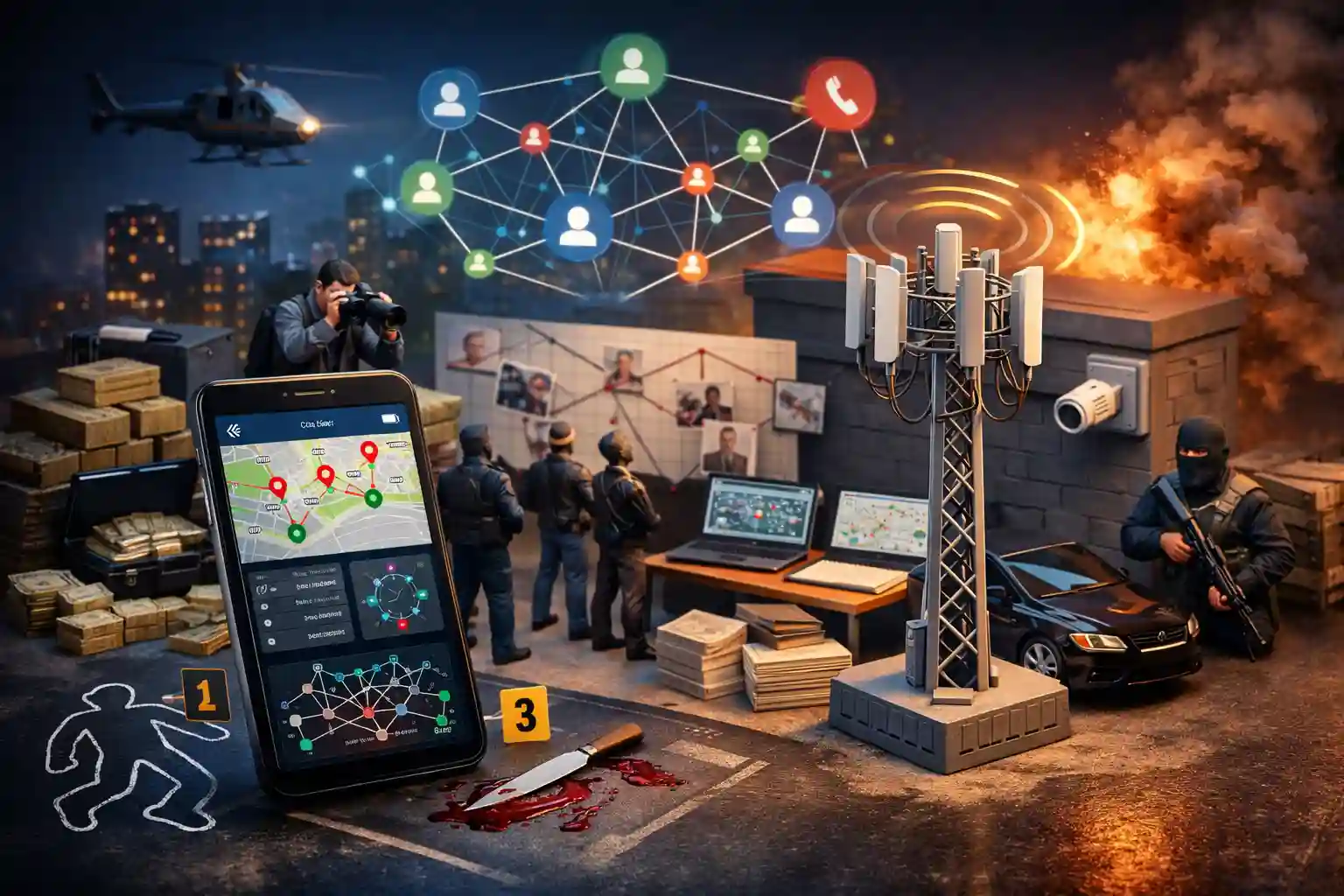
Organized Crime Is a Network Problem, Not Crime Scene Problem
Organized crime does not operate in isolation. It operates in structured communication layers.
Behind every visible offender lies an invisible ecosystem:
- Coordinators issuing instructions
- Distributors managing logistics
- Financiers routing funds
- Intermediaries buffering leadership
- Enforcers executing on the ground
Arresting a field-level operative may generate headlines. But dismantling a syndicate requires identifying the communication backbone that sustains it.
In modern smart policing, the real target is not the individual at the crime scene, it is the hidden command node operating behind layered devices, rotating numbers, and fragmented contacts.
Organized crime detection is no longer about isolated suspects. It’s about mapping ecosystems.
This is where predictive policing and crime analytics platforms like Prophecy Alethia transform investigation from reactive arrest to structured network disruption.
Key Takeaways
- Organized Crime Is Network-Driven: Syndicates operate through layered communication structures, not isolated actors.
- Communication Metadata Reveals Hidden Hierarchies: CDR and IP data expose relationship patterns and command nodes.
- Cluster & Centrality Analysis Identify Leaders: Network analytics helps pinpoint coordinators beyond field-level operatives.
- SIM RotationDoesn’tEliminate Traceability : IMEI and multi-number mapping detect behavioral continuity.
- Temporal Patterns Expose Planning Phases: Synchronized communication bursts often signal coordinated activity.
- Cross-Case Correlation Expands Intelligence Scope: Analyzing telecom data across FIRs reveals ecosystem-level crime networks.
- Predictive Policing Enables Proactive Disruption: Crime analytics platforms help intervene before networks escalate.
- Smart Policing Requires Structured Intelligence: Modern law enforcement depends on integrated communication analysis and network mapping.
Why Traditional Investigation Struggles with Syndicates

Organized crime is deliberately designed to appear fragmented.
Field realities include:
- Fragmented Communication Data: Records spread across telecom providers, devices, and jurisdictions.
- Multiple SIM Rotation: Frequent number changes to evade detection.
- Device Sharing & IMEI Masking: Shared handsets complicate identity mapping.
- Short-Burst Communication: Brief, timed coordination calls to avoid obvious patterns.
- Cross-Border & Inter-State Contacts: Jurisdictional fragmentation slows intelligence fusion.
Manual spreadsheet-based review of CDRs cannot expose network hierarchies. It surfaces calls, not structure. To dismantle organized crime, law enforcement needs crime analytics that reconnect fragments into networks.
What Is Communication Analysis in Organized Crime Detection?

Communication analysis in organized crime detection refers to the structured examination of telecom metadata, IP data, and associated identifiers to uncover hidden criminal ecosystems.
It relies on:
- Call Detail Records (CDRs)
- IP Detail Records (IPDRs)
- IMEI-device mapping
- Multi-number associations
- Timestamp correlation
- Geospatial overlays
Importantly, this is metadata analysis, not call content monitoring. When integrated into predictive policing frameworks.
communication analysis helps identify:
- Relationship patterns
- Network clusters
- Hierarchical command structures
- Command-and-control nodes
- Emerging coordination signals
This is where Prophecy Alethia’s crime analytics engine elevates raw telecom records into structured intelligence.
Core Analytical Layers in Organized Crime Detection
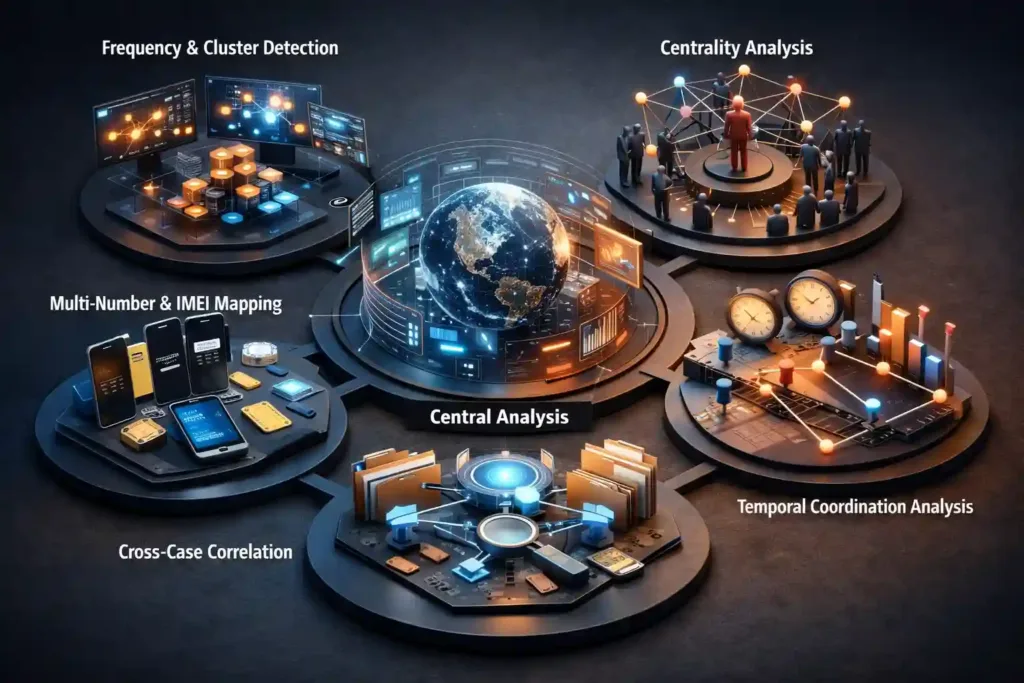
Effective organized crime detection through communication intelligence operates in layered analytics, not isolated review.
Frequency & Cluster Detection
Repeated communication patterns reveal operational teams. Crime analytics platforms detect:
- High-frequency communication clusters
- Task-based group interactions
- Repeated short-window coordination
Cluster detection helps identify operational cells within larger syndicates.
Centrality Analysis: Identifying the Command Node
In any organized network, some nodes control the flow. Centrality analytics answer:
- Who bridges multiple clusters?
- Which number connects distributors and financiers?
- Who remains active across incidents?
Rather than targeting replaceable actors, investigators identify the network’s structural leadership. This is core to predictive policing, disrupting risk hubs before escalation.
Multi-Number & IMEI Mapping
Organized groups rely on burner phones and SIM rotation. Structured analytics detect:
- Multiple SIMs in one device
- Shared IMEI patterns
- Device reuse across incidents
- Behavioral continuity despite number changes
This prevents suspects from escaping traceability through device switching.
Temporal Coordination Analysis
Organized crime often operates through synchronized bursts. Analytics detect:
- Communication spikes before major crimes
- Coordinated silence after incidents
- Sequential call chains
- Time-aligned device activity across locations
Temporal modelling reveals planning phases, enabling anticipatory intervention under predictive policing frameworks.
Cross-Case Correlation
The most powerful shift occurs when communication data is analyzed across cases.
Structured crime analytics platforms like Prophecy Alethia enable:
- Same number appearing across multiple FIRs
- Shared device identifiers across cases
- Recurring cluster structures
- Network expansion detection
This transitions investigation from case-level to ecosystem-level intelligence.
Field-Level Use Cases

Drug Distribution Network Disruption
- Identify distributor clusters
- Detect central logistics nodes
- Map upstream command layers
- Predict emerging hotspots through communication spikes
Human Trafficking Cluster Identification
- Map recruiter-to-transporter chains
- Detect inter-district coordination
- Identify repeat device usage
- Correlate communication with movement patterns
Extortion Syndicate Mapping
- Detect rotating number patterns
- Identify shared IMEI usage
- Establish hierarchical call chains
Cross-Border Terror Communication Network
- Map multi-jurisdiction contact structures
- Identify central command nodes
- Detect layered coordination
- Integrate telecom intelligence with geospatial and contextual analytics
From Individual Arrest to Network Disruption
Arresting one operative does not dismantle a syndicate.
Organized crime networks are resilient.
They are structured for replacement.
Communication intelligence allows investigators to:
- Identify command nodes
- Disrupt financial channels
- Break coordination pathways
- Prevent rapid reconstitution
This is the difference between reactive policing and intelligence-led predictive policing. Mapping the network dismantles the ecosystem.
The Role of Smart Crime Analytics Platforms

Manual CDR review cannot scale against multi-accused syndicates.
Platforms like Prophecy Alethia combine:
- Communication analysis
- Link visualization
- Centrality scoring
- Timeline overlays
- Geospatial mapping
- Cross-case crime analytics
- Risk-based prioritization
By integrating telecom metadata with broader crime intelligence datasets, Alethia supports:
- Organized crime detection
- Pattern-based risk forecasting
- Smart policing strategies
- Intelligence fusion
- Network disruption before escalation
It transforms communication analysis into a predictive intelligence engine.
To Conclude: Organized Crime Requires Predictive Intelligence
Organized crime is not random. It is structured. Coordinated. Layered. Traditional investigation exposes individuals. Crime analytics exposes networks.
Communication analysis, when embedded within predictive policing platforms like Prophecy Alethia, enables law enforcement agencies to shift from reactive arrests to proactive disruption.
In the era of smart policing, mapping criminal ecosystems is not optional, it is foundational.
The future of organized crime detection lies in structured communication intelligence, predictive analytics, and network-level intervention.
Organized crime networks evolve. Your intelligence systems must evolve faster.
Discover how Prophecy Alethia empowers law enforcement agencies with advanced crime analytics, predictive policing capabilities, and structured communication intelligence.
Schedule a Demo Today and See How Smart Policing Disrupts Criminal Networks Before They Escalate.
Frequently Asked Questions (FAQ)
1. What is communication analysis in organized crime detection?
It is the structured examination of telecom metadata and related identifiers to uncover criminal networks and command hierarchies.
2. How does predictive policing help detect organized crime?
Predictive policing uses crime analytics and communication patterns to identify risk clusters and central nodes before escalation.
3. Does communication analysis involve call recordings?
No. It relies on metadata such as numbers, timestamps, and device identifiers—not call content.
4. What is centrality analysis in criminal network mapping?
Centrality analysis identifies high-connection nodes that act as coordinators or command points within a network.
5. Can organized crime networks be detected across multiple cases?
Yes. Cross-case correlation reveals recurring numbers, devices, and clusters across FIRs.
6. How does smart policing differ from traditional investigation?
Smart policing integrates predictive analytics and structured intelligence to disrupt networks rather than only arrest individuals.
7. Why is IMEI analysis important in organized crime detection?
It links multiple SIM cards to a single device, preventing suspects from evading traceability through number switching.
8. What role does crime analytics play in dismantling syndicates?
Crime analytics transforms fragmented telecom data into structured network intelligence, enabling ecosystem-level disruption.