In today’s world, wars are no longer fought solely on battlegrounds, they’re waged across networks of data, surveillance footage, intercepted communications, and rapidly shifting intelligence streams. The modern military theatre demands not just firepower, but foresight.
And in this age of asymmetric threats, where adversaries don’t wear uniforms and battle lines are blurry, the real weapon is information, fast, accurate, and actionable.
Not long ago, intelligence workflows relied heavily on physical documents, scattered databases, and manual analysis. Reports would pass through several layers of review before making their way up the chain of command, often too late to influence outcomes. Institutional memory resided in handwritten notes and personnel rotations meant starting from scratch.
Today, that model is being challenged, and replaced.
Enter Defence Intelligence Fusion System: purpose-built platforms that consolidate intelligence from multiple sources, apply AI-driven analytics, and present insights in real time. These systems don’t just store information, they connect the dots. They help analysts identify hidden links, spot movement patterns, monitor developing threats, and empower decision-makers with a 360-degree view of the battlefield, without ever touching the public internet.
This blog unpacks what these systems really are, why they’re essential for national security, and how they mark a turning point in the evolution of defence intelligence fusion system.
Understanding the Challenge: Intelligence in Silos
Imagine a military analyst trying to understand a potential threat near a border post. A satellite image (IMINT) shows unusual construction activity. Meanwhile, a separate signal intercept (ELINT) reveals increased radio chatter in the area. A human source (HUMINT) has also reported unfamiliar movement near a local village. But none of this data is seen together. It’s stored in separate departments, in different formats, on systems that don’t talk to each other.
This is the reality of intelligence in silos, a challenge that continues to undermine defence operations worldwide.
Scattered Sources, Scattered Sense
Defence intelligence typically spans multiple disciplines:
- IMINT (Imagery Intelligence) – from satellites, drones, or reconnaissance aircraft
- ELINT (Electronic Intelligence) – from adversary radar or communication systems
- COMINT (Communications Intelligence) – from intercepted voice or text communications
- HUMINT (Human Intelligence) – field reports, informants, or interviews
- OSINT (Open-Source Intelligence) – news, social media, public data
Each of these streams plays a critical role, yet they’re often processed in isolation. Analysts must toggle between systems, request cross-department access, or even manually match information, all while working against the clock.
The Cost of Disconnection
The consequences of this fragmentation are serious:
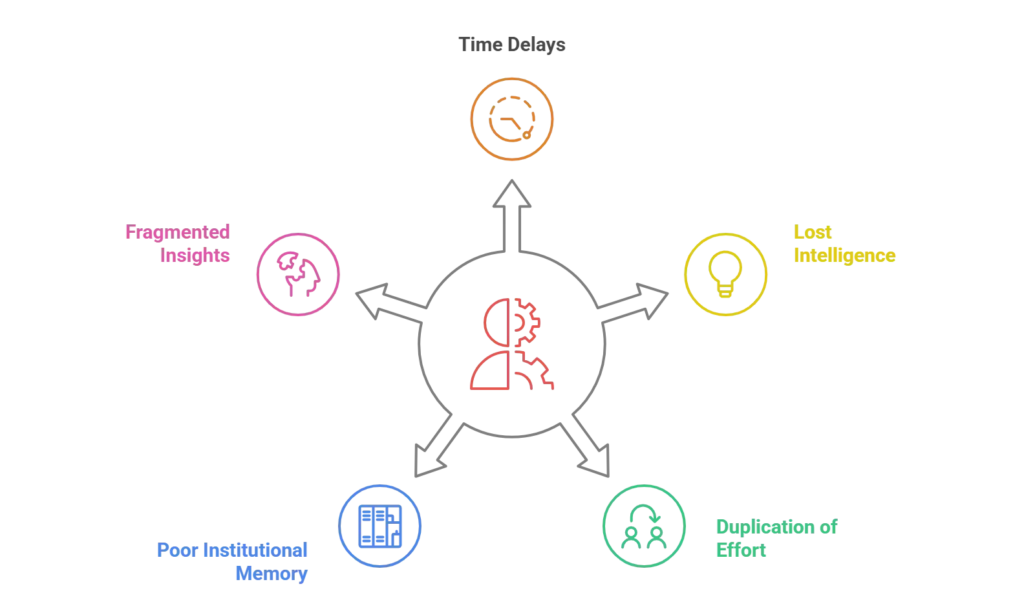
- Time delays: By the time information is correlated, the window for action may have closed.
- Lost intelligence: Without context, important signals go unnoticed or are dismissed as noise.
- Duplication of effort: Multiple teams might analyze the same event without realizing it.
- Poor institutional memory: When officers rotate or retire, their insights leave with them, with no unified historical system to carry forward knowledge.
- Fragmented insights: Decision-makers get a patchwork view instead of a unified operational picture.
In high-stakes environments where minutes matter, siloed intelligence isn’t just inefficient, it’s a vulnerability.
The answer lies in integration, not just of data, but of meaning. That’s where the Defence Intelligence Fusion System steps in, turning scattered signals into cohesive strategy.
What is a Defence Intelligence Fusion System?
At its core, a Defence Intelligence Fusion System is a secure digital platform that unifies diverse intelligence streams, correlates them in real-time, and transforms them into actionable insights for military and security decision-makers.
Unified Intelligence, Unified Action
Instead of treating each intelligence type as a standalone asset, a fusion system integrates multiple data sources, both structured and unstructured, across agencies and geographies. Here are the key domains it brings together:
- ELINT (Electronic Intelligence)
Captures data from radar systems, radio signals, and electromagnetic emissions, vital for understanding adversary electronic capabilities and movements. - IMINT (Imagery Intelligence)
Collects visual information through satellites, UAVs, or reconnaissance aircraft, helping identify installations, vehicle patterns, or terrain changes. - HUMINT (Human Intelligence)
Gathers insights from human sources, including field agents, informants, or captured reports, often offering local context or intent. - COMINT (Communications Intelligence)
Intercepts voice and text-based communications to detect planning, movement, or sentiment from adversaries. - OSINT (Open-Source Intelligence)
Mines data from publicly available channels, including news, social media, or think tank reports, to build broader context and sentiment mapping.
By correlating these inputs on a single platform, defence teams can detect patterns that would otherwise remain hidden, such as a sudden spike in radio traffic (ELINT) in a region recently observed for troop buildup (IMINT), with local informants reporting supply drops (HUMINT).

Air-Gapped for Security
Prophecy Guardian, Innefu’s defence intelligence fusion system, goes a step further. It is built to operate entirely offline, a crucial feature for national security environments. Unlike cloud-based or web-reliant systems, Guardian is air-gapped by design. It integrates data through secure pipelines without ever connecting to the public internet, ensuring the sanctity of classified information.
This offline architecture makes it not only resilient to cyber threats but also fully compliant with defence-grade security protocols, making it ideal for agencies where data leakage is not an option.
Core Components of a Fusion Platform
A Defence Intelligence Fusion System isn’t just a database, it’s an ecosystem of tools designed to turn raw data into operational intelligence. These platforms are engineered to automate correlation, extract insights, and equip defence teams with decision-ready information in real time.
Here are the essential building blocks that make this transformation possible:
1. Big Data Lake & Central Repository
All incoming data, from field reports to satellite imagery, is pulled into a single, secure repository. This centralization eliminates silos and ensures that no information, no matter how small or fragmented, slips through the cracks.
2. Optical Character Recognition (OCR)
Much of the military’s valuable intelligence still exists in physical form, typed notes, scanned PDFs, or handwritten field logs. OCR technology digitizes this content, making it searchable and analyzable. This eliminates delays caused by manual transcription and unlocks historical insights from archived files.
3. Integrated GIS Engine
The Geographical Information System (GIS) maps intelligence spatially. It allows analysts to:
- Visualize adversary activity over terrain
- Compare infrastructure changes over time
- Correlate events to specific locations
This visual layer adds an operational dimension that raw text or spreadsheets simply can’t deliver.
4. Link & Temporal Analysis
Fusion platforms go beyond basic search. They apply algorithms to connect entities, such as individuals, locations, events, or communication trails.
- Link analysis exposes hidden networks (e.g., identifying that two intercepted calls are related through a common intermediary).
- Temporal analysis helps visualize activity patterns over time, such as repeated satellite phone activations in a high-risk sector.
5. AI-Based Profiling & Querying
With built-in large language models like Minerva (custom-tuned for defence data), users can:
- Ask complex questions directly from their intelligence corpus
- Summarize lengthy reports into key highlights
- Generate unit or personality profiles from structured and unstructured data
All of this happens locally, with zero external connectivity, ensuring absolute data confidentiality.
6. Workflow & File Tracking
Every intelligence entry passes through a secure, auditable workflow. Officers can track:
- Who reviewed or edited a report
- How long a file has been pending
- Where decisions were delayed
This structured pipeline brings accountability and transparency into what was once a loosely documented process.
7. Cross-Referencing Historical Intelligence
The system enables users to instantly reference older reports, mission data, or past intelligence linked to current activity. This avoids redundant investigations and strengthens situational awareness by grounding new data in historical context.
8. Clean, Enriched, and Searchable Data
Once ingested, raw data is automatically cleaned and enriched, tagged with coordinates, dates, and metadata, making it more usable. Whether you’re querying via natural language or conducting a targeted keyword search, the system helps find precise answers fast, even in massive datasets.
Together, these components convert overwhelming volumes of data into a streamlined, insightful, and secure intelligence engine. And that’s the foundation that makes true defence-grade situational awareness possible.
The Role of AI in Intelligence Fusion
Modern defence environments generate overwhelming volumes of data, intercepted calls, satellite imagery, field reports, surveillance footage, and more. But raw information, no matter how abundant, is useless unless it’s interpreted fast, in context, and with precision.
That’s why AI is no longer a luxury in intelligence workflows, it’s a necessity.
Within Prophecy Guardian, AI is not a separate tool, it’s deeply embedded in the platform, powering every stage of analysis with real-time automation, correlation, and decision support.
AI Capabilities Within Prophecy Guardian
Text Intelligence
- Automatically summarizes long reports, helping officers grasp critical information without sifting through pages.
- Enables question-based querying from within internal data, analysts can ask natural-language questions and get fast, document-backed answers.
- Supports OCR and translation, extracting text from scanned documents or handwritten notes in multiple languages.
Visual and Image Analysis
- Performs object detection in drone footage or satellite images, such as identifying vehicles, infrastructure changes, or potential threats.
- Conducts facial recognition by comparing images against internal databases to assist in rapid identification.
- Generates contextual captions for images, saving analyst time during manual tagging and reporting.
Audio and Video Intelligence
- Converts voice communications, like field reports or radio chatter, into text with high accuracy, even under noisy conditions.
- Analyzes video streams for threat detection, identifying patterns like intrusion, movement, or unusual behavior.
- Allows teams to produce voice-based briefings or generate synthetic video content based on existing intelligence inputs.
From Overload to Insight
These AI-driven capabilities are seamlessly woven into Prophecy Guardian’s secure, offline environment, meaning no external connectivity, no cloud dependency, and no compromise on confidentiality.
By automating repetitive analysis tasks and surfacing correlations that would otherwise go unnoticed, Prophecy Guardian:
- Reduces cognitive load on analysts
- Accelerates time-to-insight
- Improves threat detection accuracy
- Enables faster, more confident decisions
In an age where intelligence windows close fast, the advantage goes to the agency that fuses speed with clarity. Prophecy Guardian delivers both, right out of the box.
Benefits of Using a Modern Fusion Platform
In defence and intelligence, clarity isn’t a luxury, it’s a tactical edge. And in high-stakes environments where one missed connection can mean a mission failure, a modern intelligence fusion system like Prophecy Guardian becomes mission-critical infrastructure.
Here are the key benefits that set it apart from traditional intelligence workflows:
1. Real-Time Intelligence, Not Postmortems
Instead of reviewing events after they unfold, Prophecy Guardian enables proactive decision-making. With built-in alerts, automated data correlation, and up-to-the-minute dashboards, command centres gain a live operational picture, not just historical analysis.
2. One Platform, All Sources
Whether it’s electronic signals, satellite images, human reports, or intercepted conversations, all data flows into a unified interface. This eliminates the guesswork and time drain of switching between fragmented systems and makes multi-domain situational awareness possible.
3. AI-Enhanced Insight at Speed
From summarizing intelligence briefs to scanning drone footage, Prophecy Guardian automates the heavy lifting. Analysts can focus on strategy rather than sifting through terabytes of raw data. The result? Faster threat detection, quicker profiling, and more informed decisions.
4. Fully Secure and Offline
Prophecy Guardian operates within air-gapped environments, with no internet connectivity, no external APIs, and no risk of data leakage. This makes it compliant with the strictest security protocols, ideal for national defence deployments.
5. Geospatial Awareness Built In
With an integrated GIS engine, the platform maps intelligence across regions, borders, or terrain in real time. Patterns become visible. Threat matrices are easier to interpret. And decisions can be made with both context and confidence.
6. Institutional Memory That Doesn’t Retire
With historical cross-referencing and long-term data retention, Prophecy Guardian ensures that intelligence doesn’t vanish with personnel turnover. It helps retain organizational knowledge, detect long-term patterns, and avoid repeating past oversights.
7. Scalable, Collaborative, and Auditable
From a field-level unit to a national command structure, the platform supports layered access, collaborative workflows, and audit trails. Intelligence no longer sits locked in individual inboxes, it becomes a shared, structured, and trackable asset.
How It’s Used in Practice
A platform like Prophecy Guardian isn’t built for the hypothetical. It’s designed for real-world complexity, where time is scarce, data is messy, and decisions can’t wait.
Here’s how defence and intelligence agencies typically use such a system in practice:
1. Mapping Infiltration Routes
When patterns emerge in satellite imagery, intercepted communications, or movement reports along a sensitive border, Prophecy Guardian brings all of it together:
- Pinpoints high-risk zones on GIS maps
- Correlates historical activity in the area
- Triggers alerts for repeated or unusual behaviors
The result? Proactive surveillance instead of reactive damage control.
2. Analyzing Intercepted Communications
If a satellite phone call is intercepted from a remote region, the platform:
- Converts speech to text
- Identifies the originating and receiving coordinates
- Links conversations to existing suspect profiles or past communication trails
Even when only fragments are available, the system helps complete the picture.
3. Detecting Hidden Networks
Many threats, from smuggling rings to proxy operatives, function in networks. Guardian’s built-in link analysis:
- Connects names, places, and timelines across reports
- Visualizes associations between individuals or locations
- Uncovers central nodes or repeat behaviors
These patterns might be invisible in isolated reports, but become clear when viewed holistically.
4. Monitoring Strategic Zones
For areas under long-term observation (like forward bases or infrastructure sites):
- Imagery is continuously ingested and compared
- Any changes, new roads, construction, or encampments, are flagged automatically
- Timelines show the evolution of activity, aiding strategic planning
This gives defence planners a temporal lens into developing threats.
5. Accelerating Investigations
When analysts face a new event, a breach, a report, a captured device:
- They can instantly cross-check relevant historical intelligence
- Search across millions of records in seconds
- Generate a consolidated profile of persons, units, or locations involved
This drastically reduces the time between event and actionable insight.
6. Supporting Command-Level Briefings
Before operations or high-level reviews:
- Officers can query the system for summaries, maps, and entity profiles
- Download visual timelines, GIS layers, and structured reports
- Build data-backed narratives without manual collation
The outcome? Confidence in what’s known, and clarity on what needs watching.
In short, Prophecy Guardian isn’t just a backend system, it becomes the nerve centre of intelligence operations, powering everything from daily monitoring to strategic foresight.
Conclusion
In an era where threats evolve faster than command chains, and where data is both a weapon and a weakness, traditional intelligence workflows simply can’t keep up. Fragmented systems, manual analysis, and siloed operations leave too much to chance, and in defence, chance is unacceptable.
That’s why platforms like Prophecy Guardian represent not just an upgrade, but a strategic shift.
By unifying intelligence sources, embedding AI at every layer, and operating securely in fully offline environments, Prophecy Guardian enables defence and intelligence agencies to do what was once impossible: See more. Understand faster. Act sooner.
This isn’t about replacing human expertise, it’s about enhancing it. Giving analysts, commanders, and field operatives the tools to not just manage complexity, but to stay ahead of it.
In modern defence, the side that fuses information best, wins. Prophecy Guardian is built for that edge.
Book a Personalized Demo
Frequently Asked Questions
1. What is a defense intelligence fusion system?
A defense intelligence fusion system is a secure platform that integrates multiple intelligence sources, like ELINT, IMINT, HUMINT, and OSINT, into a unified view to support faster, more accurate decision-making.
2. Why are traditional intelligence workflows no longer enough?
Traditional workflows often involve disconnected databases and manual analysis, leading to delays, duplication, and missed threats. Fusion platforms solve this by automating correlation across all sources.
3. Is it safe to use AI in defence intelligence systems?
Yes. Platforms like Prophecy Guardian are designed to work fully offline in air-gapped environments, ensuring total data control and compliance with national security protocols.
4. How does GIS help in defense intelligence?
GIS provides spatial context to intelligence, mapping activity across regions, borders, and terrain. It enhances threat assessments and strategic planning.