Introduction: The Urgency of Smarter Policing
On any given day, a city’s command centre might monitor hundreds of burglary reports, fraud alerts, and cyber intrusions. The challenge isn’t the lack of data; it’s making sense of it fast enough to stop the next crime before it happens.
This is where crime prediction comes in. Instead of reacting to incidents after the fact, agencies can forecast where, when, and sometimes even how crimes are likely to occur. It’s a shift from reactive policing to proactive intelligence-led strategies.
The engine powering this shift is machine learning. By analyzing patterns hidden in vast crime records, call data, CCTV feeds, and digital trails, machine learning turns fragmented intelligence into actionable foresight. What was once the work of seasoned analysts over weeks can now be done in real-time.
For law enforcement, this isn’t just a technological upgrade, it’s a matter of public safety and national security. In an era of complex, fast-evolving threats, predictive analytics in law enforcement is becoming as essential as patrol cars or radios once were.
What is Crime Prediction and Why It Matters

At its core, crime prediction is the science of using data to forecast where, when, and sometimes what type of crime is most likely to occur. Think of it as moving from “what happened yesterday” to “what could happen tomorrow.”
Unlike traditional intelligence reports that only describe past incidents, predictive policing transforms raw crime records, patrol logs, and digital traces into forward-looking insights.
This helps law enforcement allocate resources more effectively, whether that means positioning patrols in high-risk neighborhoods or monitoring emerging fraud patterns online.
Globally, agencies are investing in crime analytics not just to reduce crime rates but also to build community trust. When crimes are prevented rather than simply prosecuted, policing shifts from reactive enforcement to strategic deterrence.
In today’s security landscape, where threats span both streets and cyberspace, crime prediction is no longer optional, it’s becoming a core function of modern law enforcement.
The Role of Machine Learning in Crime Prediction

What makes crime prediction using machine learning powerful is its ability to recognize patterns across massive datasets that no human analyst could process alone.
Agencies today have access to diverse data sources: crime records, call data records (CDRs), CCTV and bodycam footage, open-source intelligence (OSINT), even financial transactions.
On their own, these datasets are overwhelming. But when fed into a crime algorithm, machine learning models uncover correlations that point to likely hotspots, repeat offenders, or suspicious behaviors.
Some common Machine Learning approaches in law enforcement include:
- Regression models → predicting crime volume in a given area.
- Classification models → flagging whether an incident fits known crime patterns.
- Clustering → grouping similar cases to identify organized crime or fraud rings.
- Anomaly detection → spotting unusual activities, like sudden spikes in ATM withdrawals.
The benefits are clear:
- Real-time insights instead of waiting for quarterly reports.
- Scalability to process millions of records simultaneously.
- Reduced analyst workload, freeing officers to focus on decision-making rather than data crunching.
By blending historical data with live feeds, machine learning in law enforcement helps agencies not just see the past but anticipate the future.
Crime Pattern Analysis – Learning From the Past

At its core, crime pattern analysis is about connecting the dots. Instead of treating each incident as isolated, it looks for recurring trends that reveal how, where, and why crimes happen.
For example:
- Burglaries may follow similar entry points or target neighborhoods with weak surveillance.
- Fraud cases across financial networks often use the same shell companies or recycled laundering structures.
This is where crime analytics becomes powerful. Machine learning models can sift through years of historical records and match them against current activity. What might look like a one-off theft to an analyst could, through pattern recognition, reveal a repeat offender moving across districts.
By linking past behaviors with present-day signals, crime pattern analysis helps agencies:
- Anticipate the next move of organized groups.
- Recognize repeat criminal tactics quickly.
- Allocate resources with data-backed confidence.
In short, it transforms hindsight into foresight, a critical step toward proactive policing.
Crime Hotspot Mapping – Predicting the ‘Where’

If crime pattern analysis tells us the what and how, crime hotspot mapping answers the critical where.
Using Geographic Information Systems (GIS) combined with machine learning, law enforcement can map high-risk zones where crimes are most likely to occur. These aren’t just static maps, they evolve as new data flows in, from police reports to CCTV feeds to citizen complaints.
A real-world example:
Police departments in major cities now use hotspot maps to deploy patrols more strategically. Instead of covering entire neighborhoods equally, resources are concentrated in areas with the highest predicted risk, improving both efficiency and deterrence.
The benefits are clear:
- Smarter allocation of manpower → more coverage where it matters.
- Faster response times → officers already near likely crime zones.
- Visible deterrence → reducing the likelihood of crimes occurring at all.
This is predictive analytics in law enforcement at work, turning maps into living intelligence tools.
From Data to Decisions: Crime Algorithms in Action

At the heart of every predictive policing system lies the crime algorithm – the engine that turns data into foresight.
Think of the workflow like this:
- Data ingestion → crime records, CDRs, CCTV, financial intelligence.
- Pattern detection → anomalies and correlations across domains.
- Prediction → probable crime events, locations, and timelines.
What makes these algorithms powerful is their ability to learn continuously. Every solved case, every new dataset, feeds back into the system, sharpening accuracy over time.
A useful analogy: weather forecasting. Just as algorithms crunch historical and real-time weather data to predict storms, crime algorithms process crime-related signals to forecast potential incidents.
The result → agencies move from reacting to crimes already committed to preventing crimes before they happen.
Applications of Predictive Analytics in Law Enforcement
Predictive analytics is no longer theoretical, it’s being applied in multiple dimensions of law enforcement to enhance both speed and accuracy.
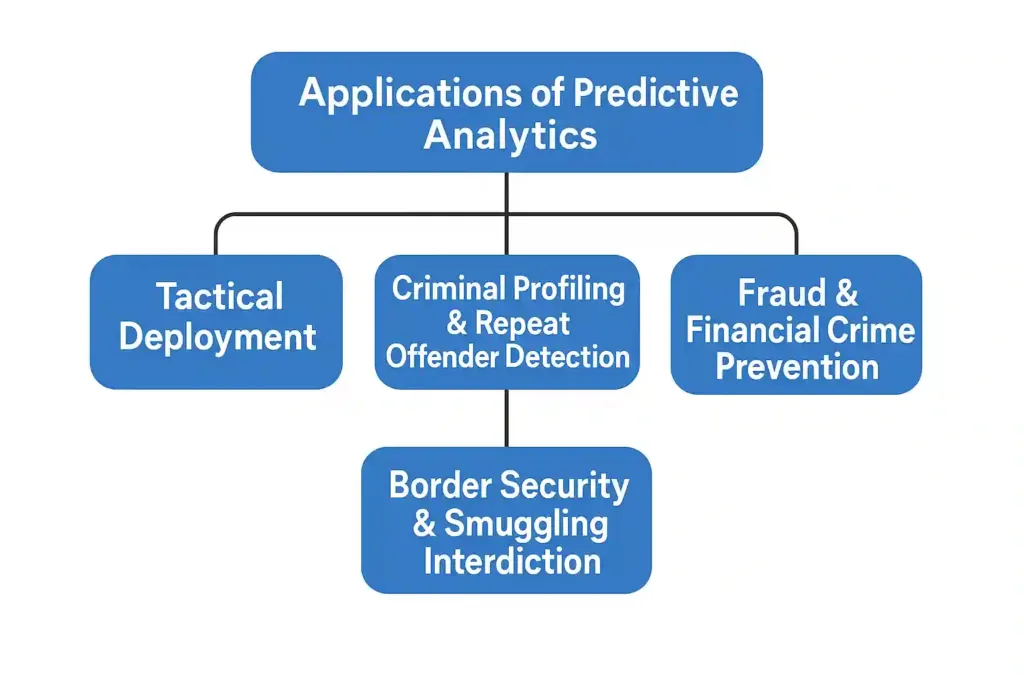
Tactical Deployment
Police forces use hotspot predictions to allocate patrols and checkpoints where they’re most needed. This ensures limited resources deliver maximum impact.
Criminal Profiling & Repeat Offender Detection
Algorithms link past offender behaviour, MOs, and case histories to flag potential repeat offenders, helping investigators act faster.
Fraud & Financial Crime Prevention
By analyzing transaction patterns across banks and fintech platforms, predictive analytics uncovers fraud rings and laundering schemes before they scale.
Border Security & Smuggling Interdiction
Combining surveillance data, sensor feeds, and intelligence reports allows agencies to detect patterns in smuggling routes and anticipate cross-border crime.
In short, predictive analytics equips law enforcement with a data-driven compass, guiding decisions that make communities safer and operations more efficient.
The Future of Crime Prediction With AI
Crime prediction is entering a new era, where machine learning converges with emerging technologies to create pre-emptive security ecosystems.

Generative AI for Scenario Simulations
Instead of relying only on historical data, generative AI can model “what-if” scenarios, simulating how criminal or adversarial behaviour might evolve. This helps agencies stress-test strategies and prepare for unexpected threats.
Air-Gapped LLMs as Analyst Assistants
Large Language Models, deployed in secure on-premise environments, can act as intelligence copilots. Analysts can query systems in natural language (“Show me smuggling cases involving drones in the past 5 years”), receiving instant, context-rich summaries. Innefu has been at the forefront of enabling this secure human-AI interaction within intelligence fusion centres.
Integration of IoT, Drones, and Satellite Data
The next generation of crime prediction will fuse multi-source data, from IoT sensors in cities to drone feeds at borders and satellite imagery over conflict zones. AI-driven fusion will allow agencies to connect dots that were previously invisible.
Toward Pre-emptive Security Ecosystems
Predictive policing is evolving from reaction to anticipation. Platforms like Innefu’s Prophecy Suite already enable agencies to unify structured and unstructured data, build institutional memory, and transition from after-the-fact reporting to foresight-driven security operations.
The future isn’t just about predicting crime,it’s about empowering agencies to stay one step ahead, making crime harder to execute and easier to intercept.
Innefu’s Contribution to Crime Prediction & Analytics
For law enforcement agencies, crime prediction isn’t just about having the data, it’s about having the right intelligence platforms to turn data into foresight. This is where Innefu’s solutions come into play.
Prophecy Alethia

Predictive Policing & Crime Analytics
Designed to anticipate rather than react, Alethia empowers agencies with predictive policing models. From spotting emerging crime hotspots to identifying repeat offenders, it transforms fragmented inputs into actionable insights.
Innsight

OSINT for Crime Pattern Analysis
Criminal networks often leave digital traces across open sources. Innsight helps analysts detect patterns, monitor online chatter, and connect open-source intelligence to ongoing investigations,building a richer crime profile.
Intelelinx

CDR-Based Crime Network Analysis
Call Data Records remain one of the most powerful tools in dismantling organized crime. Intelelinx enables advanced link analysis of communication networks, exposing hidden hierarchies and relationships among suspects.
AI Vision

Video Analytics for Surveillance Integration
With CCTV and drone data growing exponentially, AI Vision adds another dimension to crime prediction. It powers real-time anomaly detection, crowd behavior analysis, and integration of video feeds into broader intelligence fusion platforms.
Taken together, these solutions establish Innefu not just as a technology vendor, but as a trusted intelligence partner,helping agencies move toward a future where crime analytics isn’t reactive, but predictive, proactive, and precise.
Conclusion: Toward Smarter, Safer Cities
The future of policing is shifting from reaction to prediction. By harnessing machine learning, crime pattern analysis, and predictive analytics, agencies can stay one step ahead of criminals, whether it’s forecasting hotspots, analyzing communication networks, or detecting anomalies in real time.
At Innefu Labs, our suite of AI-powered platforms – Prophecy Alethia, Innsight, Intelelinx, and AI Vision, are built to help law enforcement agencies move from fragmented intelligence to mission-ready foresight.
👉 Request a demo today to see how Innefu’s solutions can transform your crime prediction and analytics capabilities.
FAQ Section
- What is crime prediction using machine learning?
Crime prediction using machine learning refers to the use of algorithms to analyze vast datasets, such as crime records, CDRs, or CCTV footage, to forecast when and where crimes are most likely to occur. - How does crime pattern analysis help law enforcement?
Crime pattern analysis identifies recurring behaviors, methods, or networks. By linking past cases to current signals, it helps law enforcement uncover hidden trends and accelerate investigations. - What is crime hotspot mapping?
Crime hotspot mapping uses geographic information systems (GIS) and predictive models to identify high-risk areas. Agencies use these insights to deploy patrols and resources more effectively. - What are crime algorithms?
Crime algorithms are the analytical engines behind predictive policing. They process data, detect anomalies, and forecast potential crime events, similar to how weather models predict storms. - How is predictive analytics used in policing?
Predictive analytics supports tactical deployment, crime prevention, fraud detection, and border security. It shifts policing from reactive reporting to proactive intervention. - What are the challenges of crime prediction?
Key challenges include data quality, bias in historical datasets, integration of siloed intelligence, and the need for transparency in algorithmic decision-making. - How does AI improve crime analytics?
AI enables faster pattern recognition, anomaly detection, and predictive modelling. It reduces analyst workload, provides real-time insights, and helps agencies anticipate rather than react to threats.