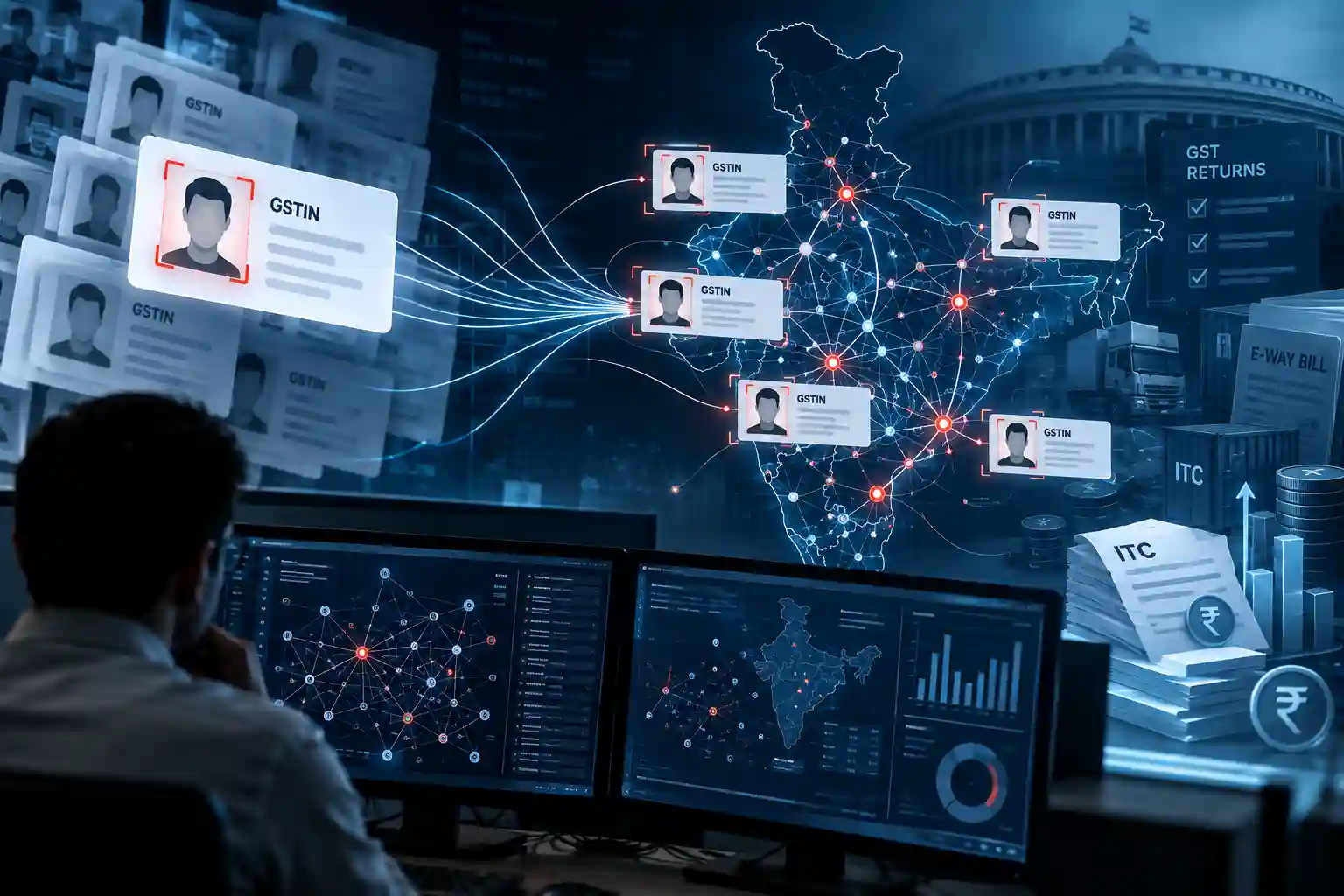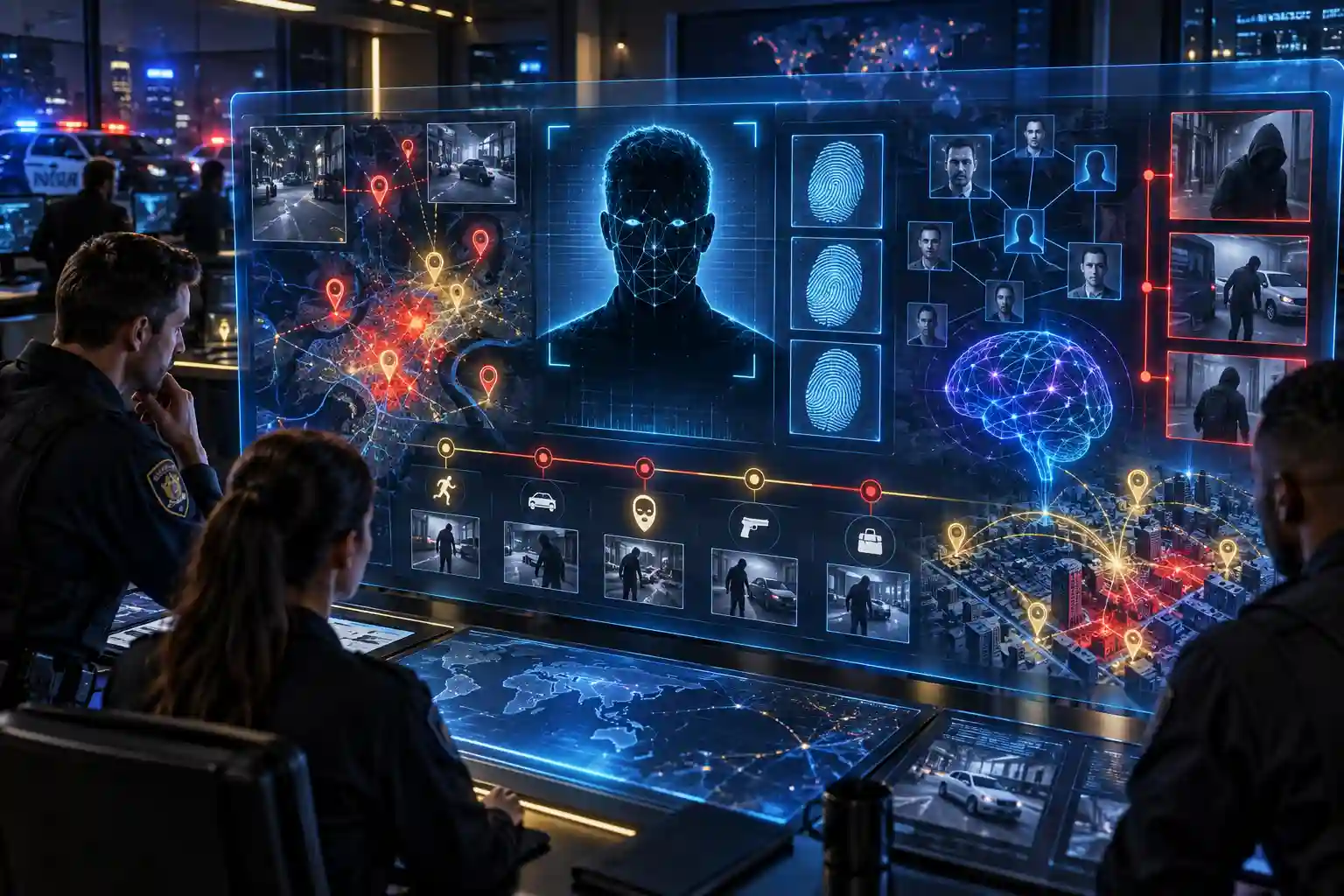
An investigating officer needs to check whether a specific modus operandi, a particular method of breaking into ATMs, say, has shown up anywhere else in the state in the last year. The information is almost certainly in CCTNS. Finding it means knowing which fields to search, which filters to apply, and how the data was likely entered by whichever officer logged it months ago in another district, possibly with a slightly different spelling or category tag.
This isn’t a CCTNS failure. It’s the nature of structured database search applied to a problem that doesn’t naturally fit into fields and dropdowns. And it points to where the next phase of CCTNS modernisation could matter most.
What CCTNS Has Already Achieved

It’s worth being clear-eyed about this first, because the achievement is real. Thousands of police stations across India are now linked through the CCTNS platform, including 100% deployment in remote areas like Manipur, Nagaland, and Lakshadweep. Over 99% of First Information Reports are now filed through CCTNS. Source: NCRB
This is a genuine national infrastructure achievement. Before CCTNS, individual police stations maintained manual records that couldn’t be shared across districts or states. CCTNS replaced that with a unified national database where police officers can search criminal records instantly from anywhere in India. The system now also flows into the Integrated Criminal Justice System, connecting police data with courts, prisons, prosecution, and forensics.
The foundation, universal connectivity, and digital FIR filing and a single national data architecture are built. CCTNS 2.0, the modernisation phase now underway, is focused on the next layer: centralized cloud hosting, enhanced analytics, and a multi-tenancy architecture that lets states share infrastructure while keeping their data isolated and customisable.
This is exactly the right foundation on which to ask the next question: once the data is connected, how easily can an officer actually find what they’re looking for inside it?
The Access Problem That Connectivity Alone Doesn’t Solve

CCTNS supports search by specific parameters, name, vehicle number, or criminal modus operandi. That’s a meaningful capability. It’s also a structured one: it works well when the officer knows precisely which field to search and how the relevant record was likely categorised.
Real investigative questions are rarely that clean. An officer doesn’t always start with “Search by MO code 4471. “They start with something closer to “find anything that looks like this.” Bridging that gap, from a real, often messy investigative question to the right structured query, currently depends on the officer’s familiarity with the system, time available, and a degree of luck about how the relevant record was originally entered.
A few specific friction points recur across CCTNS use, and they aren’t unique to India; they’re inherent to structured database search applied to investigative work:
Spelling and transliteration variance
Names transliterated from regional languages into the system don’t always follow a consistent spelling. A search for one spelling can miss records entered under a slightly different one.
Category and field inconsistency
Data accuracy and consistency across all states remains difficult, and interoperability with older, legacy state-level software creates technical bottlenecks. The same type of incident can be logged under different categories in different states, or even different stations within the same state.
The query has to be structured before the search starts
An officer working a fast-developing case often doesn’t have time to figure out the right combination of filters, fields, and codes. The information they need might be a single search away if they knew exactly how to ask for it.
Not all states use all CCTNS modules to their full potential, and a meaningful part of that underutilisation is a usability gap, not a willingness gap. A system that requires precise structured input is, in practice, a system that a busy investigating officer under time pressure may not fully use.
Why This Matters More Now Than It Did a Decade Ago

CCTNS was built for a CrPC-era investigative tempo. The new criminal laws that came into effect in July 2024 prompted 23 functional modifications to the CCTNS application, including stricter timelines for investigation updates and senior officer approvals. BNSS’s 60- and 90-day chargesheet filing windows mean an investigating officer has less slack than before to spend time figuring out how to phrase a database query correctly.
The cost of slow database access isn’t abstract anymore. It’s measured against the same statutory clock that determines whether a chargesheet gets filed on time.
What Natural Language Search Actually Changes
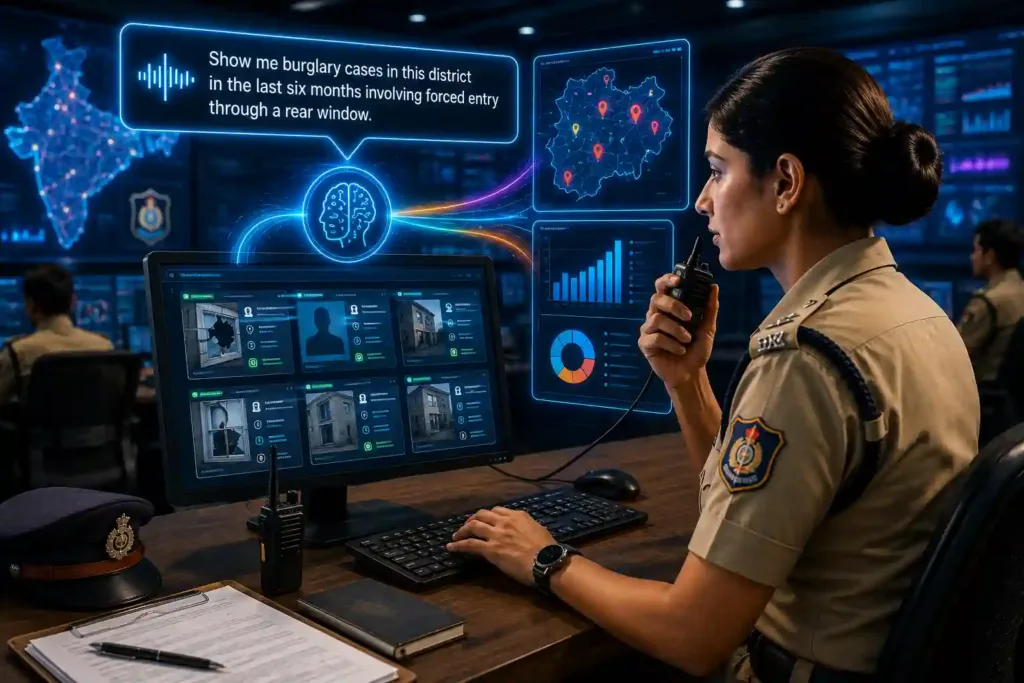
Natural language search lets an officer type or speak a query the way they would describe it to a colleague, “Show me burglary cases in this district in the last six months involving forced entry through a rear window,” and have the system interpret that request, map it to the correct fields and categories, and return matching records, regardless of how those records were originally tagged or spelt.
This isn’t a hypothetical capability. India’s own NITI Aayog and Ministry of Statistics and Programme Implementation have already moved in this direction at the national level. The National Statistics Office introduced a Model Context Protocol server on its e-Sankhyiki portal in February 2026, enabling users to query government datasets directly using AI tools in plain language without downloading large files. The same natural language approach is being extended to NDAP, India’s National Data and Analytics Platform, which integrates datasets across 52 ministries and 31 sectors.
The direction of travel for Indian government data systems is clear: natural language access is becoming the standard expectation, not an experimental feature. CCTNS, holding far more operationally urgent data than most government datasets, is a strong candidate for the same shift.
What this could mean specifically for CCTNS-style crime data
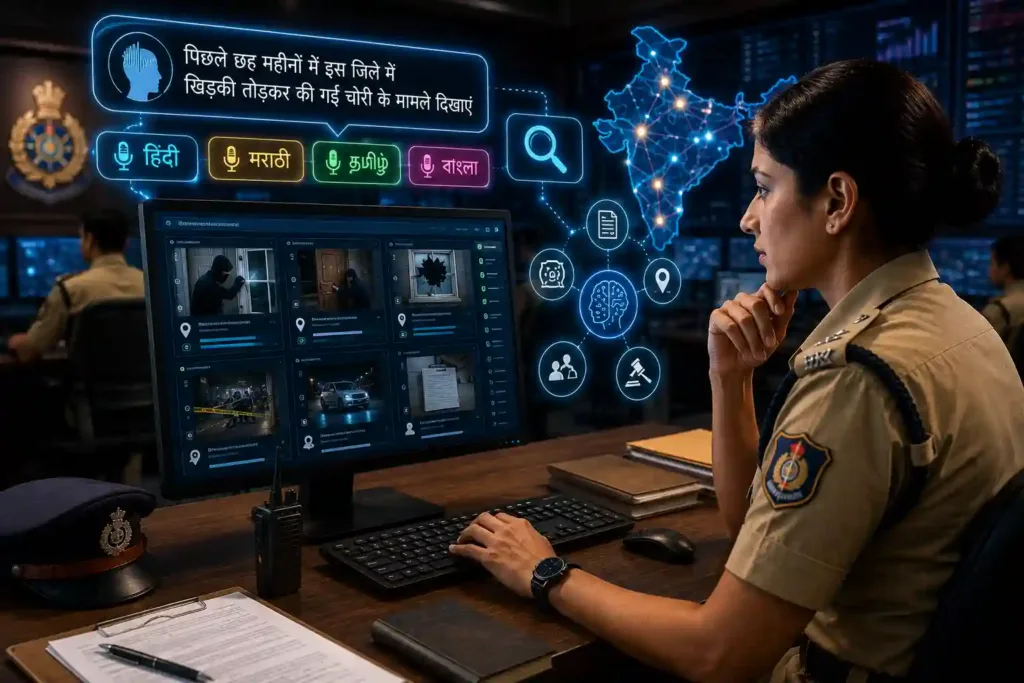
A query phrased in plain language, in the officer’s working language, Hindi, Marathi, Tamil, Bengali, or any of India’s major regional languages, interpreted correctly regardless of the exact terminology used. In a country with 22 scheduled languages, this capability isn’t a convenience feature; it’s a structural necessity for a system meant to serve every state.
Search results that aren’t limited to exact-match fields. A query about a method of operation could surface records categorised slightly differently across districts, because the system is matching on meaning and context rather than requiring an exact category match.
Lower training overhead for new officers and constables rotating into investigative roles, since the system is queried the way a question is naturally asked rather than through a fixed set of structured filters that take time to learn.
This is the same underlying capability that Sarvagata AI, Innefu Labs’ agentic AI platform, describes as natural language to database querying, the ability to query internal databases, including crime records, in plain language without writing structured query syntax. Applied to a system architecture like CCTNS, this is the kind of capability layer that could sit on top of the existing infrastructure rather than replacing it.
To Conclude

CCTNS solved the problem it was built to solve: connecting 17,000-plus police stations into a single national system, replacing manual, siloed records with a shared digital infrastructure. That achievement is the reason a next-generation access layer is even worth discussing; there’s now a single, connected dataset worth making easier to query.
The remaining gap isn’t whether the data exists. It’s whether an officer, in the middle of an active investigation, can find what they need by describing it the way they’d describe it to a colleague rather than by knowing the right field, the right code, and the right spelling in advance.
That is what natural language search offers as a capability. India’s own government data platforms are already moving in this direction. CCTNS, holding the country’s most operationally urgent dataset, is a natural next candidate.
Frequently Asked Questions
1. What is CCTNS, and what does it currently do?
CCTNS (Crime and Criminal Tracking Network and Systems) is a nationwide platform connecting all the police stations across India into a single digital system for filing FIRs, chargesheets, and investigation records and for searching a national database of crime and criminal records. It is implemented by the National Crime Records Bureau under the Ministry of Home Affairs and is integrated with the Integrated Criminal Justice System, which links police data with courts, prisons, prosecution, and forensics.
2. What is natural language search and how would it apply to crime databases?
Natural language search allows a user to query a database using ordinary spoken or written language, the way they would describe a question to a colleague, rather than navigating structured fields, dropdowns, or query syntax. Applied to a crime database, this would mean an officer could type or speak a description of what they’re looking for, and the system would interpret the request, map it to the relevant records, and return matches even if those records were originally logged using different terminology or categorisation.
3. Is natural language search currently available in CCTNS?
No. CCTNS currently supports search by specific structured parameters such as name, vehicle number, or modus operandi code. Natural language search is not a current CCTNS feature. It is an emerging capability that other Indian government data platforms, including NITI Aayog’s NDAP and the Ministry of Statistics’ e-Sankhyiki portal, have begun adopting and represents a plausible direction for CCTNS 2.0’s ongoing modernisation.
4. Why does data inconsistency across states make CCTNS search harder?
Different states and even different police stations within the same state can log similar incidents under different categories, with varying spelling conventions for names transliterated from regional languages. Structured search requires matching the exact field or term used at the point of entry, so inconsistent data entry across more than 17,000 police stations means a structured query can miss relevant records that exist in the system but were tagged differently. Natural language and semantic search approaches are designed to match on meaning rather than exact terms, which is one reason they are being explored for large, federated government datasets.
5. How does the BNSS timeline framework increase the urgency of CCTNS search improvements?
BNSS sets fixed windows for filing chargesheets, 60 or 90 days depending on the offence, and a 90-day limit for further investigation. These statutory deadlines mean investigating officers have less time to spend manually working out how to structure a database query correctly. A search interface that returns relevant results on the first attempt, regardless of how the query is phrased, has more operational value under these tighter timelines than it did under the previous CrPC framework.
6. What would it take to deploy natural language search safely on a system as sensitive as CCTNS?
Any natural language search layer added to CCTNS would need to operate entirely within the same government-controlled infrastructure and security boundaries that govern the rest of the system, with no data routed through external or third-party servers. This is the same sovereignty requirement that applies to any AI capability layered onto sensitive government data; the search interface can change, but the data’s residency and access control cannot.