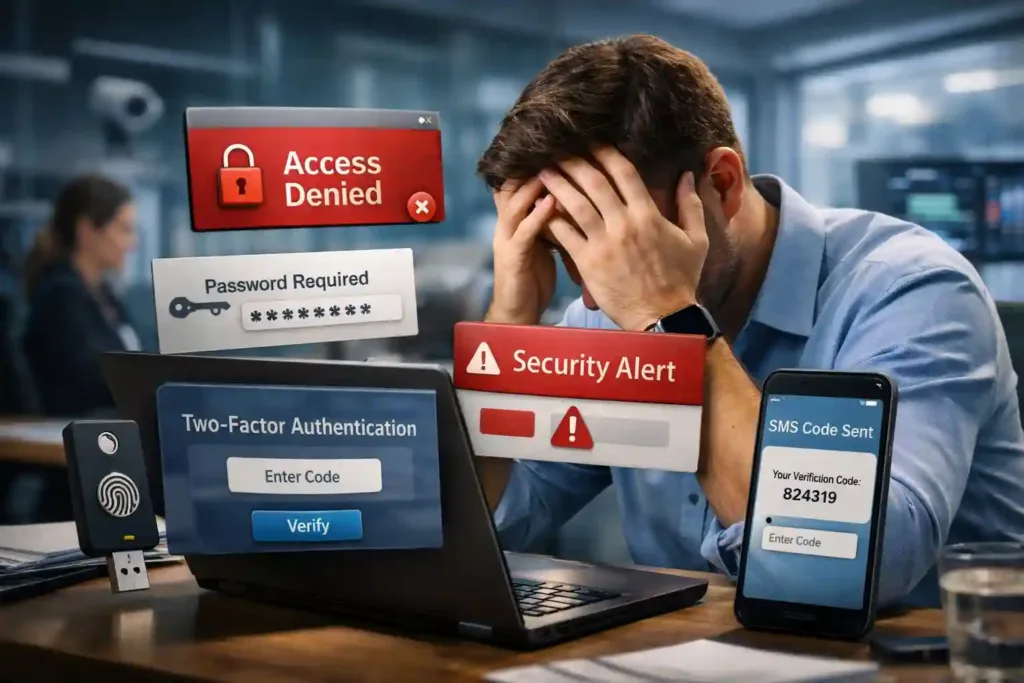
It is 4:30 PM on a Tuesday. An employee has been authenticating all day, laptop login, VPN, three web applications, a privileged system, a remote desktop session. She receives a push notification. She approves it.
She did not initiate a login.
She approved it because she has approved dozens of them today. The prompt looks like every other prompt. She is tired. The alternative is to stop what she is doing, examine the notification carefully, decide if it is legitimate, and potentially lock herself out while she investigates, disrupting her own work.
She approves it.
This is authentication fatigue. And it is one of the most significant and least technically complex vulnerabilities in enterprise security today, because it does not require a zero-day exploit, a sophisticated attack tool, or any particular technical skill. It requires only a workforce that authenticates frequently enough to stop paying attention.
Key Takeaways
- Authentication fatigue is a design problem: Not a user behaviour problem. Training users to “be more careful” does not work at scale against repetitive, low-stakes prompts.
- MFA fatigue attacks (MFA bombing) are a documented, active attack technique: Attackers send repeated authentication requests hoping a fatigued user approves one.
- Standard push notification approval is the highest-fatigue MFA method: A single tap with no cognitive engagement is the easiest to automate and the easiest to approve without reading.
- The solution is fewer prompts, not more warnings: Adaptive authentication that challenges only when risk warrants it reduces fatigue while maintaining security.
- Biometric authentication eliminates the prompt-fatigue loop at the workstation level: A fingerprint scan is not a prompt that can be blindly approved.
- PKI-based challenge-response push is structurally more resistant than standard push: It requires active engagement with the specific authentication context, not a blind approval tap.
- The goal is authentication that is invisible when risk is low and assertive when risk is high: That is the architectural answer to fatigue.
Why “Train Your Users” Doesn’t Solve This
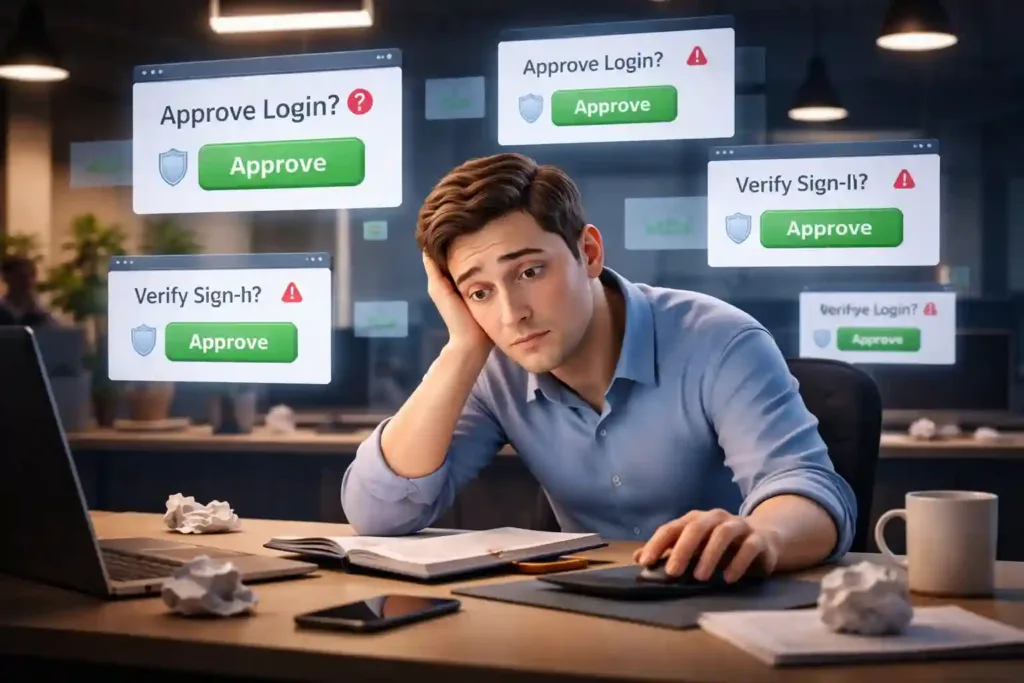
When authentication fatigue causes a security incident, the instinctive organisational response is awareness training. “Remind staff not to approve prompts they didn’t initiate.” Send a security bulletin. Add a slide to the annual compliance training module.
This approach fails for a structural reason: it asks humans to maintain perfect, consistent vigilance on a repetitive low-stimulus task, indefinitely, under time pressure, across every working day.
Human beings are not built for this. Vigilance on repetitive tasks degrades over time, this is not a character flaw, it is how attention works. Security systems that depend on sustained human vigilance against fatigue are systems that will eventually fail, regardless of how much training is delivered.
The security industry has known this for years in other contexts, which is why we do not design fire safety systems that require employees to always remember to close fire doors manually. We install self-closing mechanisms. The protection is structural, not behavioural.
Authentication fatigue requires the same thinking: design the system so that fatigue-driven approval does not create vulnerability, rather than demanding that users maintain vigilance the system architecture does not support.
What Authentication Fatigue Actually Looks Like in Practice

Understanding the specific failure modes helps in designing the right interventions.
MFA bombing, the deliberate attack
An attacker has obtained an employee’s username and password, through phishing, credential stuffing, or purchase on a dark web marketplace. They cannot get past MFA. So they send repeated push notification requests, sometimes dozens, sometimes hundreds, until the employee approves one to make the notifications stop.
This attack has succeeded against organisations with mature security programmes precisely because it exploits human behaviour rather than technical vulnerability.
Passive fatigue, the everyday risk
No attacker is required. Simply the volume of legitimate authentication prompts across a working day creates a baseline level of inattention.
Users who authenticate many times daily treat each prompt as a routine interruption rather than a security decision. The cognitive engagement that the prompt was designed to create is absent.
Approval-without-reading, the default behaviour at scale
When push notifications arrive consistently alongside legitimate work activity, users learn to associate their appearance with a login they just initiated and approve without verifying.
This learned association is exploitable: an attacker who times a fraudulent push to coincide with the employee’s normal working hours and normal access patterns has a high probability of an approval.
The Architectural Fix: Fewer Prompts, Smarter Prompts

The solution to authentication fatigue is not more prompts with more urgent language. It is a system that challenges users only when the risk of the access attempt actually warrants it, and when it does challenge, makes that challenge meaningful rather than a tap that takes 0.3 seconds.
Adaptive authentication, challenge based on risk, not on schedule
An authentication system that evaluates the context of every access attempt, device, location, network, time, behavioural baseline, and adjusts the challenge accordingly reduces fatigue by eliminating unnecessary prompts.
A routine login from a known workstation on the corporate network during normal hours should not require a step-up challenge. An access attempt from an unfamiliar location, outside normal hours, on a new device should. Context-aware systems challenge when it matters. Standard MFA challenges every time, regardless.
The result is not less security, it is the same security applied intelligently. Low-risk sessions proceed with minimal friction. High-risk sessions trigger stronger verification. Users experience fewer prompts.
When a prompt does arrive, it is more likely to represent a genuinely anomalous event, which means it receives more attention. The signal-to-noise ratio of authentication prompts improves.
Biometric authentication, eliminate the prompt loop at the workstation
A fingerprint scan cannot be blindly approved. There is no notification to dismiss, no button to tap without reading. The user must physically present their biometric characteristic, which takes active participation. This eliminates the specific fatigue mechanism of push notifications at the workstation login level.
The authentication event becomes faster than a password entry while being structurally immune to the blind-approval failure mode.
PKI-based challenge-response push, make the prompt cognitively engaging
When a push notification is used, the design of that notification matters. A standard push notification asks: “Approve or deny?” A PKI-based challenge-response notification presents specific contextual information about the login attempt, application, location, device, and requires the user to actively verify that it matches what they initiated.
This is not a tap. It is a brief active decision that re-engages attention. It is also cryptographically signed, meaning the notification itself cannot be spoofed or replayed.
Number matching and context injection
An extension of the above: some push implementations require the user to match a number displayed on their login screen to one presented in the notification, confirming they are approving the specific session they initiated. This small additional step breaks the blind-approval pattern effectively.
Network and time policies, eliminate prompts outside authorised contexts
If an employee’s role does not require system access outside working hours or from outside the corporate network, access attempts in those contexts can be denied outright rather than challenged. This removes the entire prompt, and the fatigue risk, for access scenarios the organisation has decided should not occur.
AuthShield: Built to Eliminate the Conditions That Create Fatigue

AuthShield‘s architecture addresses authentication fatigue at every layer described above.
Its adaptive authentication engine, built on trained ML algorithms, evaluates every login in context and applies the appropriate verification level. Low-risk sessions do not generate unnecessary prompts. High-risk sessions trigger stronger verification. The challenge frequency is proportionate to actual risk, not to the system’s need to demonstrate it is working.
Its one-touch push notification uses PKI-based challenge-response rather than a standard approval tap. The notification carries specific authentication context, and the user’s approval is tied to that specific session, not a generic confirmation that can be given without reading.
Its fingerprint biometric authentication deploys for Windows login, web applications, and enterprise systems, removing push notifications from the highest-volume authentication event entirely. The workstation login becomes a touch, not a prompt. No notification. No blind-approval risk.
Its AI-driven facial recognition extends the biometric layer to scenarios where fingerprint input is impractical, providing the same prompt-elimination benefit across a broader range of access contexts.
Its network and time policies, and geo-fencing controls, allow administrators to define precisely the conditions under which authentication is permitted, eliminating prompts for access attempts that fall outside the defined parameters rather than challenging users on access that should not be occurring at all.
The result is an authentication architecture where the volume of prompts users experience is materially lower than standard MFA deployment, every prompt that does appear carries meaningful contextual information, and the most common authentication event, workstation login, does not involve a prompt at all.
For the broader architecture behind reducing authentication friction without reducing security, read: Risk-Based Authentication →
For a full comparison of how biometric and OTP factors compare on fatigue and security, read: OTP vs Biometric Authentication →
Frequently Asked Questions
1. What is authentication fatigue in enterprises?
Authentication fatigue is the erosion of vigilance that occurs when employees are required to respond to authentication prompts so frequently that they begin approving them automatically, without evaluating whether each prompt is legitimate. It is a security risk because it enables both deliberate attacks (MFA bombing, where attackers send repeated requests hoping for a fatigue-driven approval) and passive vulnerabilities (where legitimate-looking fraudulent prompts are approved as a matter of habit).
2. What is an MFA fatigue attack?
An MFA fatigue attack, also called MFA bombing, is a technique where an attacker who has obtained valid credentials sends repeated push notification authentication requests to the victim, hoping they will approve one to stop the notifications. The attack exploits the human response to persistent interruption rather than any technical vulnerability. It has been used successfully against organisations with strong overall security postures because it bypasses technical controls entirely.
3. How does adaptive authentication reduce authentication fatigue?
Adaptive authentication evaluates the context of each login attempt, device, location, network, time, behavioural baseline, and challenges the user only when the risk profile of that attempt warrants it. A routine login from a known context requires minimal verification; an anomalous login triggers stronger challenges. By eliminating prompts for genuinely low-risk sessions, adaptive authentication reduces the total prompt volume users experience, reducing fatigue without reducing the security applied to genuinely risky access attempts.
4. Is biometric authentication immune to MFA fatigue?
Biometric authentication eliminates the specific failure mode of blind push-notification approval at the workstation level, because there is no notification to approve without reading. A fingerprint scan or facial recognition event requires active physical participation from the user, which re-engages attention in a way that a tap on a notification does not. However, biometrics should still be combined with other factors for high-sensitivity access; the goal is an authentication architecture where every factor contributes meaningfully rather than creating a new single point of failure.
5. What is the difference between standard push notifications and PKI-based challenge-response push?
Standard push notifications ask the user to approve or deny access with a single tap, typically with minimal contextual information about the specific login attempt. PKI-based challenge-response notifications carry specific information about the session being authenticated, application, device, location, and the user’s approval is cryptographically bound to that specific session. This requires active reading and engagement rather than a reflexive tap, and cannot be spoofed or replayed because the cryptographic binding is session-specific.
6. Can authentication fatigue be solved by reducing MFA requirements?
Reducing MFA requirements reduces fatigue by reducing prompts, but at the cost of reducing security. The right answer is not fewer challenges, but smarter challenges: adaptive authentication that applies strong verification where risk warrants it and minimal friction where it does not. This achieves the prompt reduction benefit without the security reduction cost. Blanket reduction of MFA requirements is not an appropriate response to authentication fatigue; contextual, risk-based reduction is.
Authentication fatigue is real, it is exploitable, and it is not solved by telling users to pay more attention. The enterprise security systems that handle it well are the ones that acknowledge the human reality, that sustained vigilance on repetitive tasks degrades, and design around it rather than against it.
Fewer prompts when risk is low. Stronger, more engaging challenges when risk is high. Biometric authentication where the prompt loop itself needs to be eliminated. That is the architecture.