
The Era of Financial Data Saturation
Walk into any financial enforcement unit today and the challenge is immediately visible, not as silence, but as volume. Transaction logs expand by the hour. GST filings move in cycles. E-way bills cross state borders in real time. Banking systems generate layered transaction trails. Telecom metadata captures device movement. Suspicious Transaction Reports (STRs) flow in continuously under regulatory mandates.
On paper, this should make financial crime investigations easier. In practice, it has made them more complex. The scale of digital financial transactions has grown faster than investigative infrastructure. Taxation, banking, payments, telecom, and logistics systems all generate structured and semi-structured data, but much of it exists in isolation. GST records sit in one system, bank data in another, device intelligence somewhere else, and OSINT signals outside the core workflow.
The result is a paradox: enforcement agencies have unprecedented data access, yet extracting intelligence remains difficult.
Financial data analytics tools often operate within departmental boundaries. AML monitoring systems generate alerts but lack contextual depth. Tax fraud detection mechanisms flag anomalies without correlating them across jurisdictions or linked entities. Investigators are left with:
- Alerts without context
- Reports without relational insight
- Data without integration
Much of the effort goes into stitching information together manually, exporting spreadsheets, cross-checking identifiers, reconciling mismatched formats. This is not a data shortage problem. It is a financial data silos problem. It is an enforcement data fragmentation problem.
As regulatory obligations expand and AML monitoring challenges intensify, the strain becomes structural. More reporting does not automatically translate into more clarity. The real challenge is not lack of data, it is lack of intelligence integration.
Key Takeaways
- Financial crime thrives on data fragmentation, integration is the real advantage.
- Traditional AML systems are reactive; AI enables predictive fraud analytics.
- Multi-source financial data correlation uncovers hidden networks and shell entities.
- Knowledge graph and geospatial analytics expose relational and geographic fraud patterns.
- Proactive risk scoring transforms investigations from case-based to intelligence-driven.
- A financial intelligence fusion center embeds institutional memory into enforcement systems.
Why Traditional Fraud Investigation Systems Are Failing

Most financial investigation systems were built for a different era, one where fraud cases were smaller, datasets were manageable, and patterns were simpler. They were designed around cases, not networks. A complaint is registered. A case file is opened. Data is collected within defined boundaries. Analysis happens within that scope. A report is generated.
This linear model struggles against modern financial crime.
Today’s fraud networks operate as interconnected ecosystems: layered shell entities, shared directors, mule accounts, circular invoicing chains, synthetic identities, and cross-border transfers. Yet many traditional AML systems and tax investigation platforms still treat cases as isolated units.
This creates structural inefficiencies:
- Case-based silos where intelligence remains confined to individual files
- Manual link analysis limitations, relying on spreadsheets and static charts
- Reactive AML workflows that trigger action only after thresholds are breached
- Delayed detection, where funds have already been layered or withdrawn
- Static reporting instead of dynamic, evolving risk scoring
- Cross-case intelligence gaps, where the same director or device goes unnoticed across systems
These inefficiencies are not due to lack of effort. They are architectural. Fraud networks adapt because they operate as connected systems. Investigations often do not.
This structural mismatch, between networked crime and siloed enforcement, makes a different model necessary. One that mirrors the interconnected nature of financial crime itself.
What Is an AI-Powered Financial Intelligence Fusion Framework?

An AI-powered financial intelligence fusion framework is not another dashboard layered over existing databases. It is a structural shift in how financial crime investigations are conducted.
At its core, it’s a unified intelligence ecosystem designed to integrate fragmented enforcement systems into a cohesive analytical environment.
Instead of treating GST data, banking records, telecom metadata, device intelligence, and OSINT inputs as separate investigative streams, the framework brings them together. It enables:
- Multi-source financial data integration
- AI-driven anomaly detection
- Dynamic entity relationship mapping
- Automated risk scoring
- Cross-case intelligence correlation
- Actionable outputs instead of static reports
In operational terms, this is what a modern financial intelligence fusion center looks like, not a data repository, but an intelligence engine.
Core Components
A functional fusion framework typically includes:
- Financial transaction analytics to detect irregularities across GST filings, bank records, and regulatory submissions.
- OSINT integration to incorporate reputational, sanctions, and open-source signals.
- GIS mapping to visualize geographic transaction patterns and clustering.
- Knowledge graph analytics to map relationships between entities, directors, accounts, and devices.
- Synthetic identity detection to uncover duplicated or manipulated identities.
- Real-time alert management to dynamically adjust risk scoring as new data flows in.
An AI financial fraud detection system built on fusion principles does more than detect anomalies, it contextualizes them across datasets, entities, and investigations.
Core Pillars of a Financial Intelligence Fusion Framework
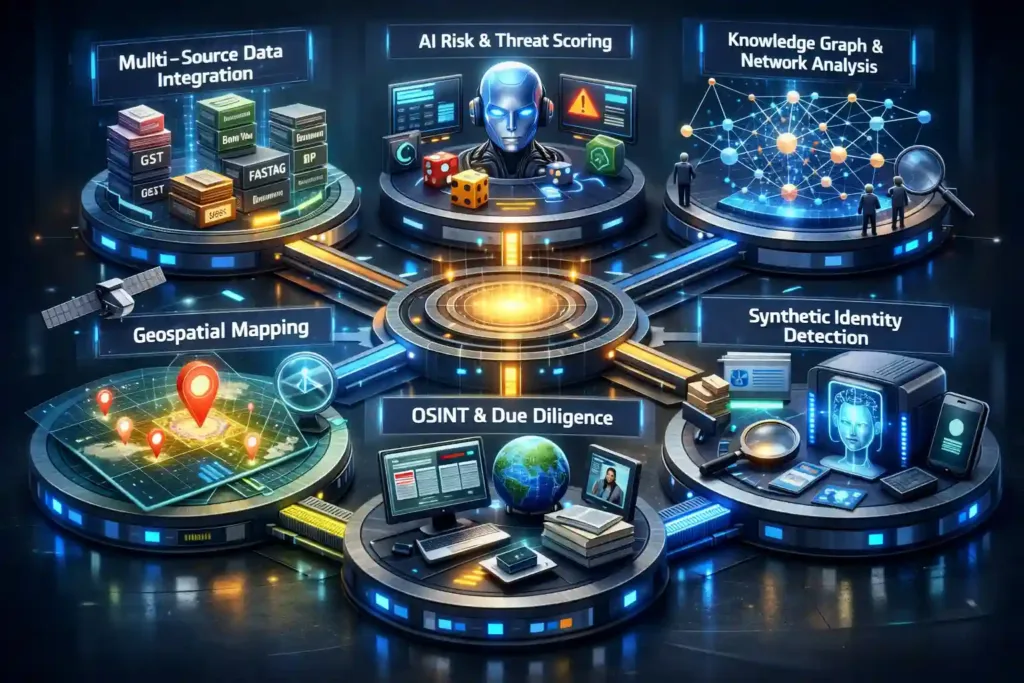
Multi-Source Financial Data Integration
Financial crime rarely leaves evidence in one place. It is distributed across systems. An effective fusion architecture enables correlation across:
- GST filings (GSTR-1, GSTR-3B)
- E-way bill data
- Bank transaction records
- FASTag mobility patterns
- Telecom metadata
- Device and IP fingerprints
When integrated, these datasets allow cross-platform financial investigation at scale. GST fraud analytics, for instance, becomes far more powerful when invoice data is correlated with banking flows, director linkages, and device patterns.
Integration is the foundation. Without it, intelligence cannot scale.
AI-Driven Risk & Threat Scoring
Once data is unified, AI enables interpretation. Modern systems support:
- Entity-level risk scoring
- Transaction-level anomaly detection
- Behavioral pattern analysis
- Adaptive fraud models
Rather than relying on fixed thresholds, AI risk scoring evaluates evolving behavior and relational context. Predictive fraud detection becomes possible when models update continuously instead of periodically. The system begins identifying early risk signals, not just obvious red flags.
Knowledge Graph & Network Intelligence
Financial crime is relational by design. Shell companies share directors. Mule accounts share devices. Transactions pass through layered networks. Knowledge graph analytics enables:
- Entity resolution across databases
- Shell company network mapping
- Director interlinking
- Hidden beneficial ownership detection
Unlike static charts, graph-based systems dynamically expand relationship networks. In complex cases, link analysis often reveals fraud structures far faster than manual review.
GIS & Geospatial Mapping
Fraud patterns also have geographic dimensions. Geospatial fraud analytics helps detect:
- Suspicious clustering of entities
- Circular trading routes
- Regional concentration of transactions
- Heatmap-based transaction flows
In scenarios like carousel fraud, geographic visualization exposes routing patterns that tabular analysis might miss.
OSINT-Driven Due Diligence
Structured financial data alone does not capture full risk exposure. OSINT-driven AML due diligence adds layers such as:
- Sanctions screening
- Adverse media monitoring
- Reputation analysis
- Vendor risk signals
This enhances monitoring by integrating external intelligence into entity risk profiles.
Synthetic Identity Detection
Synthetic identity fraud is increasingly sophisticated. Advanced systems detect:
- Facial biometric overlaps
- Device fingerprint reuse
- Breached email patterns
- Disposable number usage
Identity fraud detection powered by AI shifts investigations from reactive response to proactive prevention.
Real-World Applications

The value of a fusion framework becomes evident in operational use.
In GST fraud investigations, correlating invoices, banking flows, and director relationships helps identify circular invoicing and vanishing traders early.
In AML transaction monitoring, suspicious transaction clustering and mule network detection replace isolated alert review.
In shell company disruption, director overlaps and shared infrastructure expose layered networks.
During post-raid analysis, indexed device data and financial records can be instantly mapped to existing networks.
Most importantly, cross-case intelligence consolidation breaks investigative silos. Patterns identified in one investigation automatically inform risk scoring elsewhere.
Financial intelligence stops being reactive documentation and becomes a continuously evolving capability.
From Detection to Prevention: The AI Shift

For decades, financial crime systems have focused on detecting violations after they occur. But fraud is not an event, it is a process.
Entities are formed. Networks expand. Devices are reused. Transaction patterns evolve gradually. Systems designed only for threshold-based detection will always remain one step behind. AI changes that dynamic.
Predictive Modeling
Predictive fraud analytics analyzes historical cases, behavioral signals, and relational patterns to anticipate emerging risk. Instead of asking whether a rule was violated, the system evaluates whether an entity is beginning to resemble known fraud networks.
Proactive Entity Risk Scoring
Proactive AML monitoring continuously updates risk profiles based on transaction behavior, network associations, geographic signals, and OSINT inputs. Risk scores evolve in near real time.
Contextual Real-Time Alerting
AI reduces alert fatigue by prioritizing risk clusters rather than isolated events. Alerts are accompanied by network context, enabling faster decision-making.
Continuous Learning
Fraud tactics evolve quickly. AI models adapt through feedback loops and dynamic recalibration, ensuring sustained predictive fraud analytics capability.
Institutional Intelligence Memory
Perhaps most critically, intelligence becomes cumulative. Patterns identified in one case inform future risk assessments. Entity associations persist across investigations. Knowledge is embedded structurally rather than residing in individual files.
The result is a shift from reactive enforcement to preventive governance. AI financial crime prevention reduces exposure before systemic damage occurs. In increasingly digitized financial ecosystems, that transition is not optional, it is structural.
Conclusion: From Fragmented Data to Integrated Financial Intelligence
Financial crime is no longer isolated, linear, or slow-moving. It is networked, adaptive, and deeply embedded within digital ecosystems. Enforcement systems that remain fragmented, no matter how data-rich, will continue to operate reactively.
The future of fraud investigations lies not in accumulating more reports, more dashboards, or more alerts. It lies in integration. An AI-powered financial intelligence fusion framework transforms how agencies approach financial crime:
- It replaces siloed datasets with unified intelligence environments.
- It shifts from static reporting to dynamic, evolving risk scoring.
- It moves from transaction-level alerts to network-level insights.
- It converts reactive AML monitoring into predictive fraud analytics.
When multi-source financial data correlation, knowledge graph analytics, geospatial intelligence, and proactive risk scoring operate within a single ecosystem, investigations begin to mirror the structure of the fraud networks they are designed to dismantle.
This is where concept meets operational reality. Platforms like Prophecy Eagle I, designed as an AI-powered financial intelligence fusion centre, operationalize this framework for enforcement agencies. By integrating GST filings, e-way bills, banking records, OSINT signals, device intelligence, and network analytics into a unified architecture, it enables investigators to move from fragmented analysis to coordinated, intelligence-led action.
Frequently Asked Questions (FAQ)
1. What is an AI-powered financial intelligence fusion framework?
It is an integrated system that unifies multi-source financial data, such as GST filings, banking records, telecom metadata, and OSINT signals, into a single intelligence environment. It combines AI-driven analytics, knowledge graph mapping, and risk scoring to enable coordinated fraud investigations.
2. How does predictive fraud analytics improve investigations?
Predictive fraud analytics identifies emerging risk patterns before regulatory violations fully materialize. By analyzing behavioral signals, entity relationships, and transaction anomalies, it enables proactive intervention instead of post-incident response.
3. What role does a knowledge graph play in financial crime detection?
A knowledge graph maps relationships between entities, directors, accounts, devices, and transactions. This helps investigators uncover hidden networks, shell company structures, and mule account linkages that may not be visible in isolated datasets.
4. How is proactive AML monitoring different from traditional AML systems?
Traditional AML systems rely on rule-based alerts triggered after thresholds are crossed. Proactive AML monitoring uses dynamic risk scoring and behavioral analysis to continuously assess entity risk in near real time.
5. Why is multi-source financial data correlation important?
Financial crime evidence is distributed across systems. Correlating GST data, banking transactions, device intelligence, and geospatial information provides a complete investigative view and prevents cross-case intelligence gaps.
6. How does a financial intelligence fusioncentersupport enforcement agencies?
A financial intelligence fusion center centralizes data integration, AI analytics, risk scoring, and cross-case correlation within one architecture. This improves speed, accuracy, and coordination across investigations while building long-term institutional intelligence.