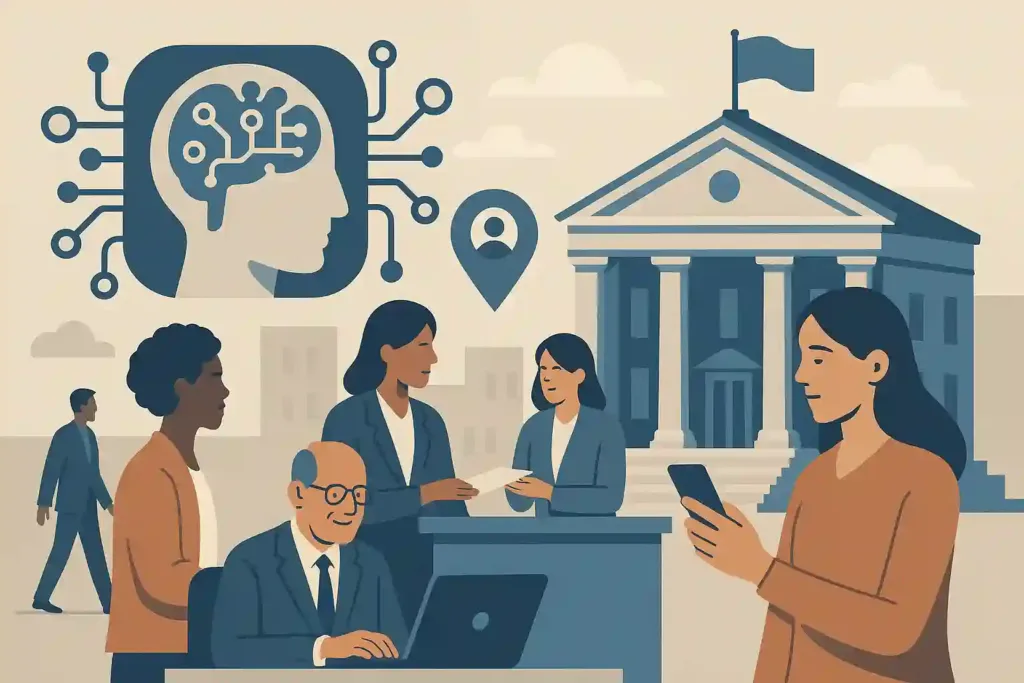
Artificial Intelligence (AI) is no longer limited to cutting-edge tech labs or private enterprises. Around the world, governments are embracing AI to modernise public services, streamline administration, and improve citizen experiences. From digital IDs and fraud detection in welfare schemes to multilingual chatbots and predictive infrastructure maintenance, AI-driven tools are reshaping how governments operate.
According to industry reports, the global AI market in the public sector is projected to cross $40 billion by 2030, growing at a CAGR of more than 30%. A 2025 EY survey revealed that while 64% of government leaders believe AI could deliver significant cost savings, only 26% have deployed AI at scale.
In the United States, over 1,700 AI use cases have already been reported by federal agencies, spanning healthcare, defense, law enforcement, and citizen services. Singapore is testing ambitious agentic AI deployments on secure air-gapped clouds, while India is scaling AI for governance, digital services, and public safety.
For organizations like Innefu Labs, which specialize in Big Data Analytics, LLMs, NLP, Generative AI, Image & Video Analytics, Speech-to-Text, AI-powered OSINT, CDR/IPDR Analytics, SIEM/DFIR, and secure authentication systems, this represents a unique opportunity to enable governments with advanced intelligence capabilities.
Key Takeaways
AI Modernises Citizen Services: Governments can automate applications, predict demand, and deliver more personalised, inclusive services.
Fraud Detection Saves Public Money: Machine learning highlights anomalies in welfare, tax, and procurement, reducing leakages and increasing trust.
Smart Cities Become Proactive Cities: Real-time analytics optimise transport, utilities, and emergency responses, improving quality of life.
Multilingual Access Promotes Inclusion: NLP and translation tools make digital portals accessible to citizens in multiple languages and dialects.
Secure, Ethical AI Builds Trust: Data sovereignty, transparency, and fairness are essential for public adoption of AI systems.
Innefu Labs Delivers Mission-Centric AI: With secure deployments and government-specific models, Innefu accelerates public sector transformation responsibly.
AI’s contribution in Public Sector Transformation
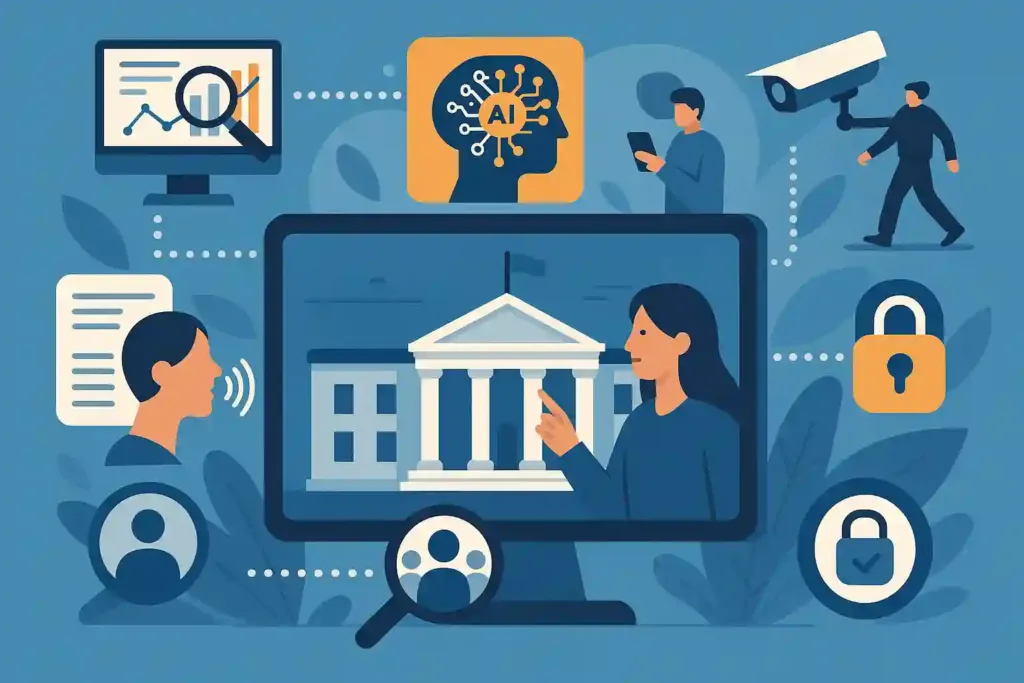
AI is about integrating advanced AI technologies into public administration, intelligence, and service delivery. It goes beyond basic automation, leveraging:
- Big Data Analytics for Intelligence Fusion Center.
- LLMs & NLP to simplify interaction with Government own confidential data.
- Image & Video Analytics to support surveillance and law enforcement.
- Speech-to-Text for real-time transcription of courts and legislatures.
- AI-powered OSINT for proactive intelligence.
- CDR/IPDR Analytics to track communication patterns in counter-terrorism.
- SIEM/DFIR platforms for cyber defense.
- Two-Factor Authentication for secure access to government platforms.
Benefits of AI in Public Sector
AI adoption in government is already reshaping governance in measurable ways. The biggest impact lies in citizen services, where virtual assistants and NLP-driven systems reduce waiting times and increase accessibility.
Another major advantage is operational efficiency. A UK government study found that AI tools save civil servants an average of three hours per week, time that can be redirected toward strategic decision-making.
Governments are also relying on predictive analytics to make data-driven policy decisions, ranging from demographic forecasting to climate risk management. AI is proving especially valuable in national security, where fraud and anomaly detection systems are helping to curb financial leakages in welfare and taxation.
Core Domains Where AI Is Transforming Government Services
Smart Cities & Urban Planning
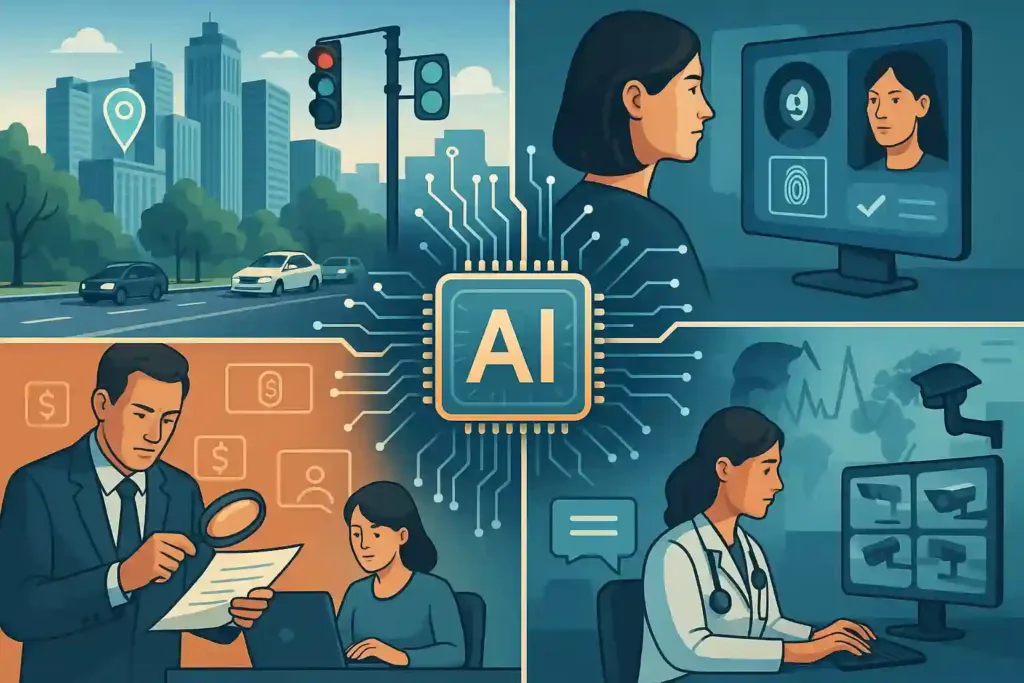
AI ingests data from traffic sensors, CCTV feeds, utilities, and environmental monitors to guide infrastructure planning. Cities can adjust traffic lights in real time, predict water shortages, or flag areas prone to illegal dumping. This data-driven approach results in smoother commutes, cleaner streets, and more efficient municipal spending.
Fraud Detection in Welfare & Taxation
AI excels at anomaly detection. In welfare distribution, machine learning can uncover duplicate or fake beneficiaries, reducing leakages and ensuring aid reaches the right people. In taxation, AI detects under-reporting or suspicious refund claims across millions of records — boosting revenue without harassing honest taxpayers.
Digital Identity & Secure Access
Biometric authentication and multi-factor verification allow citizens to securely access portals for health insurance, pensions, or municipal services. AI-powered identity checks reduce impersonation, protect sensitive records, and give citizens confidence in digital government.
Healthcare & Public Health Analytics
During the pandemic, predictive modelling helped many governments anticipate hospital demand and infection spikes. Going forward, AI can support preventive care, streamline claims processing, and detect fraud in public health reimbursements.
Citizen Engagement & Multilingual Services
Natural Language Processing (NLP) allows chatbots to converse in dozens of regional languages, simplifying access for citizens who struggle with formal paperwork or English-based portals. This is especially transformative in diverse countries like India.
Law Enforcement & Public Safety
While the focus is on citizen services, AI also enhances safety. Link analysis tools map hidden networks in organised crime; predictive analytics optimises patrols and resource deployment. Integrating CCTV with AI-driven analytics helps monitor public spaces more effectively, spotting anomalies before they escalate.
Challenges and Considerations
Despite the promise, governments must navigate key challenges. Data security and privacy are critical, as public institutions handle highly sensitive citizen information. Ethical AI guidelines emphasize eliminating bias and ensuring fairness in law enforcement and welfare decisions.
Legacy IT systems present another hurdle. Integrating AI requires significant infrastructure modernization, alongside workforce reskilling so civil servants can effectively manage AI systems. Finally, governments must work within evolving regulatory frameworks to ensure compliance and accountability.
Global Perspectives on AI for Public Sector Tranformation
- India: The government is adopting AI for digital governance, healthcare, and defense intelligence. NITI Aayog’s AI strategy outlines national initiatives, including AI-powered translation to bridge 22 official languages. Innefu Labs contributes with AI-powered OSINT, CDR/IPDR platforms, and analytics tools.
- UAE: The UAE’s AI strategy aims to make the country a global AI hub by 2031, with AI projected to contribute 14% to GDP. AI agents already manage smart city operations and citizen services.
- Israel: With an annual $2 billion AI R&D budget, Israel focuses on defense, cybersecurity, and predictive analytics.
- Africa: AI could add $1.5 trillion to Africa’s economy by 2030. Governments are deploying AI for agriculture, subsidies, and social protection. Fraud detection platforms from companies like Innefu are well-positioned to support this growth.
- United States: Federal agencies disclosed 1,700+ AI use cases, with Generative AI adoption increasing 9x in two years. AI is already saving billions annually through fraud detection and service automation.
- United Kingdom: Nearly 70% of UK’s 210+ government departments are using AI tools. Efficiency gains include an average of three hours saved per employee per week.
- Singapore: Singapore leads in secure adoption of AI, testing agentic AI on air-gapped clouds. AI is expected to add $115 billion to its economy by 2030.
How Innefu Enables AI-Powered Public Sector Transformation
Innefu Labs combines AI innovation with a deep understanding of public-sector requirements. Its platforms are built for secure on-premises or hybrid deployments, ensuring governments maintain full control of their data. Key offerings include:
Fraud Analytics Engine – Detect anomalies in welfare, tax refunds, or procurement.
Identity & Access Management – Multi-factor, biometric-secured access to e-governance portals.
Predictive Analytics Platform – Forecast demand or risks across infrastructure, health, and revenue streams.
OSINT & Data Fusion Tools – Combine open-source and internal government data for richer insights.
Incident Response & Forensics – Speed up digital investigations within public agencies.
By fusing these capabilities, Innefu helps governments not only digitise but intelligently modernise their operations.
Conclusion
The adoption of AI in public sector transformation is not a matter of if but when. From predicting health crises to strengthening national security, AI has already proven its transformative potential. Countries such as India, UAE, Israel, Africa, the U.S., the UK, and Singapore are leading the way, and the future promises even deeper integration of AI in governance.
With its expertise in AI, Big Data, Generative AI, NLP, Image & Video Analytics, and cybersecurity, Innefu Labs is positioned as a trusted partner for governments worldwide, enabling them to deliver safer, smarter, and citizen-first services.
FAQ Section
Q1: What does “AI in public sector transformation” mean?
It refers to using artificial intelligence to modernise government operations — automating services, detecting fraud, optimising resources, and improving citizen engagement — all within secure and compliant frameworks.
Q2: How can AI improve citizen services?
AI streamlines applications, predicts service demand, provides multilingual support, and flags anomalies in welfare or tax systems to improve efficiency and fairness.
Q3: How is public sector AI different from private sector AI?
Governments must prioritise data sovereignty, transparency, ethical use, and integration with legacy systems. Mission-centric AI platforms are built specifically for these needs.
Q4: What role does Innefu Labs play in this transformation?
Innefu Labs delivers secure AI solutions for fraud analytics, predictive governance, identity verification, and OSINT/data fusion — tailored to government requirements.
Q5: Is AI replacing government workers?
No — AI empowers officials to make faster, better decisions by automating repetitive tasks and surfacing actionable insights, rather than replacing them.