
Crime Analytics in the Age of AI
Today’s criminal footprint doesn’t stop at the crime scene. It stretches across social media posts, encrypted messaging, financial transactions, and CCTV cameras spanning entire cities. Offenders operate across jurisdictions, networks, and digital ecosystems, making crime not just a physical act, but a digital and cross-border one.
Traditional crime analysis was built for a different era. Analysts relied on paper reports, siloed databases, and weeks of manual cross-checking to identify patterns. This worked when data streams were limited, but modern policing now faces an avalanche of information: live video feeds, social chatter, call data records, and public databases all flowing at once. In such a fragmented landscape, critical links can go unnoticed or emerge too late to matter.
This is where artificial intelligence (AI) steps in. Acting as a powerful integrator, AI can ingest and unify multiple intelligence streams, from open-source intelligence (OSINT) to CCTV analytics to communication mapping. It rapidly processes and correlates signals, surfaces anomalies, and highlights hidden relationships that would take human teams weeks to uncover.
In this blog, we’ll explore how AI transforms crime analytics from isolated snapshots into a full 360° view. You’ll see how modern AI-driven tools combine social data, surveillance insights, and communication mapping to give law enforcement a deeper, faster, and more actionable understanding of emerging threats.
Key Takeaways
- Crime analytics leverages data to understand, predict, and prevent crime, moving law enforcement from reactive to proactive operations.
- AI integrates multiple intelligence streams: OSINT, CCTV/video analytics, and communication mapping.
- Benefits include: faster threat detection, integrated intelligence, proactive resource allocation, large-scale link analysis, and real-time situational awareness.
- Responsible AI matters: transparency, explainability, and privacy ensure trust and accountability in policing operations.
- AI-driven crime analytics acts as a force multiplier, turning raw data into actionable, timely insights.
What is Crime Analytics?
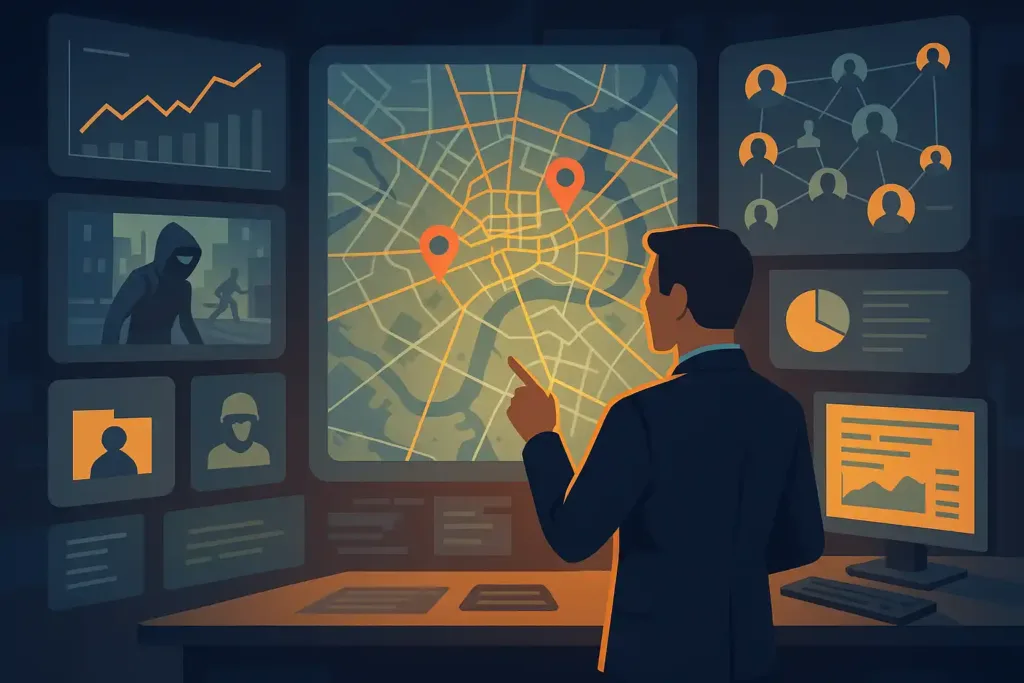
At its simplest, crime analytics means using data to understand, predict, and prevent crime. It’s the science of turning disparate information – incidents, behaviors, locations, and networks, into insights that help law enforcement act smarter and faster.
Traditionally, crime analytics relied on manual methods. Analysts would compile spreadsheets, sift through case files, and manually compare reports to find patterns. This “old-school” approach was time-intensive, prone to human error, and often produced insights only after crimes had already occurred.
AI-driven policing software has transformed this landscape. Instead of weeks of data crunching, AI can ingest and process millions of records in seconds, across multiple formats and sources.
It connects structured data like call records and case histories with unstructured data like video, social media, and open-source intelligence, producing real-time dashboards and alerts.
The difference is profound:
- Old-school analytics: Siloed databases, delayed insights, reactive response.
- AI-driven analytics: Multi-source integration, real-time analysis, proactive decision-making.
In other words, crime analytics powered by AI shifts law enforcement from a rear-view-mirror approach to a forward-looking one, allowing agencies to anticipate risks, optimize resources, and intervene before incidents escalate.
The Data Universe of Modern Policing
Modern policing no longer deals with a single stream of information, it operates in a complex web of digital, physical, and social data. Three core pillars form the backbone of crime analytics today.

Each represents a crucial piece of the puzzle that, when stitched together with AI, produces a far more complete picture of criminal activity.
Open-Source Intelligence (OSINT)
Social media posts, public records, online forums, and open databases offer a goldmine of public information. Investigators use OSINT to track emerging threats, gauge sentiment, and identify connections between people, places, and events.
Yet this data is vast, fast-moving, and unstructured,AI is essential to surface meaningful signals amid the noise.
Surveillance & CCTV Analytics
Cities and critical infrastructures are now blanketed with cameras, generating an unending stream of visual data. With AI-powered video analytics, law enforcement can move beyond passive recording to real-time insights.
Capabilities include object recognition, facial identification, vehicle tracking, and crowd behaviour analysis, all critical for situational awareness during public events or high-risk operations.
Communication Mapping
Call data records, email metadata, and other digital trails reveal how networks communicate and coordinate. By mapping these interactions, investigators can identify hierarchies, intermediaries, and hidden links within criminal groups.
AI automates the detection of unusual patterns, high-frequency connections, or sudden communication blackouts that may indicate illicit activity.
Taken individually, each pillar offers valuable insights but remains incomplete. Combined, they create a multidimensional intelligence picture. AI acts as the integrator, stitching together OSINT, CCTV analytics, and communication mapping to uncover patterns invisible when each source stands alone.
This integrated approach turns fragments of data into actionable intelligence.
How AI Integrates OSINT, CCTV Analytics, and Communication Mapping
AI doesn’t just process data, it connects the dots across vastly different sources to reveal actionable intelligence. The integration flow can be understood in four key steps:
Data Ingestion Layer
The first step involves pulling in both structured and unstructured data streams. Structured data includes call records, financial logs, and official reports, while unstructured data comes from social media posts, CCTV footage, and text-based OSINT sources. AI systems are designed to ingest this heterogenous data in real time, ensuring no valuable signal is lost.
Entity Resolution
Multiple datasets often reference the same individual or entity in different ways. AI performs entity resolution, merging fragmented identities to create a unified “person of interest” profile. This step is critical for connecting interactions across social platforms, communication networks, and physical surveillance.
Pattern & Anomaly Detection
Once identities are unified, AI looks for patterns and anomalies. It can detect unusual movements, unexpected communication bursts, or interactions that deviate from established behavioral norms. These insights help investigators prioritize leads and focus resources where they are most needed.
Visualization Dashboards
Finally, insights are presented via dynamic dashboards. Network graphs reveal relationships, heat maps highlight high-risk areas, and real-time alerts notify authorities of emerging threats. These visualizations translate complex, multi-source intelligence into clear, actionable information for decision-makers.
Benefits of AI-Driven Crime Analytics
AI-driven crime analytics goes beyond data processing, it empowers law enforcement with actionable intelligence. By unifying multiple data streams and applying advanced algorithms, agencies gain a significant operational edge.
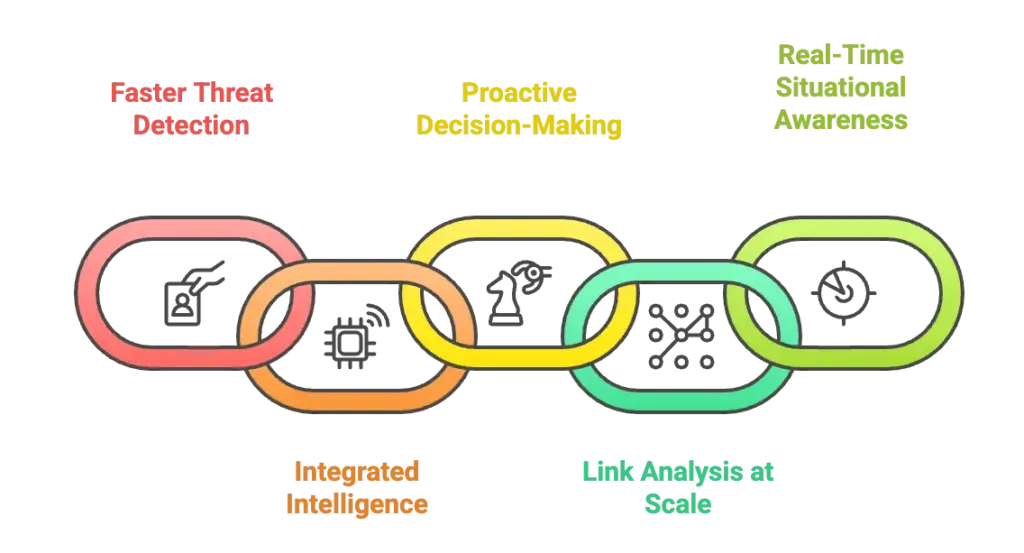
Key benefits include:
Faster Threat Detection
AI can identify potential risks and suspicious patterns before they escalate into actual incidents. Early alerts allow law enforcement to intervene proactively, preventing crimes rather than simply responding after the fact.
Integrated Intelligence
Fragmented data can obscure critical connections. AI breaks down silos between social media signals, surveillance footage, and communication networks, providing a unified intelligence picture. This integration ensures that no insight is overlooked.
Proactive Decision-Making
With real-time insights, agencies can allocate patrols, investigations, and other resources more efficiently. AI-driven analytics helps prioritize high-risk areas, optimize staffing, and plan operations based on predictive trends rather than guesswork.
Link Analysis at Scale
AI excels at uncovering hidden networks and influencers within criminal activity. By mapping connections across communications, social interactions, and movement patterns, investigators can detect coordinated behavior that may remain invisible through manual analysis.
Real-Time Situational Awareness
During public events or high-risk operations, AI provides an immediate understanding of evolving scenarios. Dynamic dashboards, heat maps, and alerts allow officers and decision-makers to respond swiftly and accurately, enhancing public safety.
In essence, AI-driven crime analytics transforms raw data into a force multiplier, enabling law enforcement to act smarter, faster, and more strategically in a complex criminal landscape.
Conclusion
AI is redefining crime analytics, transforming fragmented social, surveillance, and communication data into actionable intelligence. By integrating OSINT, CCTV analytics, and communication mapping, law enforcement agencies gain a 360° view of emerging threats, enabling faster response, proactive decision-making, and deeper insights into criminal networks.
Crucially, these tools work best when paired with responsible AI practices, ensuring transparency, fairness, and privacy. AI doesn’t replace human expertise, it augments it, helping agencies act decisively in an increasingly complex world of crime.
FAQs – Frequently Asked Questions
Q1. What is AI-driven crime analytics?
AI-driven crime analytics uses artificial intelligence to integrate multiple data sources – OSINT, CCTV/video feeds, and communication records, to detect patterns, predict risks, and support proactive policing.
Q2. How does AI improve threat detection?
AI identifies anomalies, unusual patterns, and potential risks in real time, allowing law enforcement to act before incidents escalate.
Q3. What types of data are used in AI crime analytics?
Common data sources include open-source intelligence (social media, public records), surveillance footage (CCTV, drones), and communication records (call logs, email metadata).
Q4. Why is integration important in crime analytics?
Integrating diverse datasets breaks silos, uncovers hidden networks, and produces a unified intelligence picture that single-source analysis cannot achieve.
Q5. How does AI support responsible policing?
Through explainable models, secure data handling, and privacy-conscious analytics, AI ensures decisions are transparent, accountable, and aligned with ethical standards.
Q6. What are the real-world benefits of AI-driven crime analytics?
Benefits include faster crime trend detection, optimized resource allocation, uncovering hidden criminal networks, and enhanced situational awareness during operations.