When a Crowd Turns in Minutes
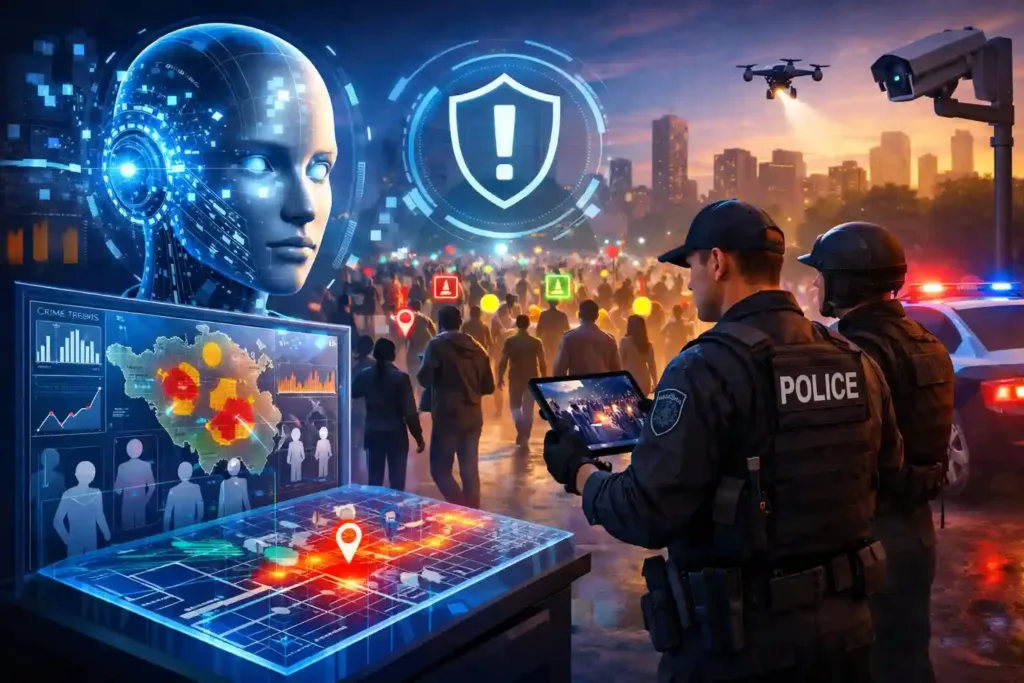
It begins as a routine deployment. A peaceful public gathering. Tens of thousands assembled. Families, volunteers, security personnel, all moving in predictable flows. Inside the control room, officers monitor multiple CCTV feeds across large display walls. Everything appears stable.
Then, within minutes, conditions change.
A sudden crowd density spike near a main entry gate.
A bottleneck forming at an exit corridor.
An isolated altercation that draws attention.
A ripple of panic movement that spreads faster than announcements can contain.
In high-density environments, escalation does not always begin with visible violence. It often begins with subtle indicators, pressure points, directional shifts, clustering patterns.
In law and order situations, the difference between stability and chaos can be measured in minutes.
The real challenge is not responding once disorder has started. It is detecting the early signals that precede escalation.
AI-based crowd monitoring is transforming how law enforcement agencies anticipate, assess, and manage high-density environments, shifting from reactive control to proactive risk detection.
Key Takeaways
1. Crowd Escalation Happens Quickly: Small density shifts can escalate into major incidents within minutes.
2. Manual Monitoring Has Limitations: Human operators cannot continuously detect subtle early warning signals.
3. AI Detects Early Risk Indicators: Crowd density, movement anomalies, and behavioral deviations are flagged in real time.
4. Predictive Policing Enhances Preparedness: Data-driven insights enable proactive resource allocation.
5. Smart Policing Improves Response Speed: Automated alerts reduce reaction time during law and order situations.
6. AI Vision Enables Real-Time Situational Awareness: Video analytics convert CCTV feeds into actionable intelligence.
7. Prophecy Alethia Integrates Crowd Data with Crime Analytics: Historical and contextual insights strengthen predictive risk management.
8. Intelligent Crowd Monitoring Strengthens Public Safety: Structured analytics help prevent incidents before escalation.
Why Crowd Management Is Increasingly Complex
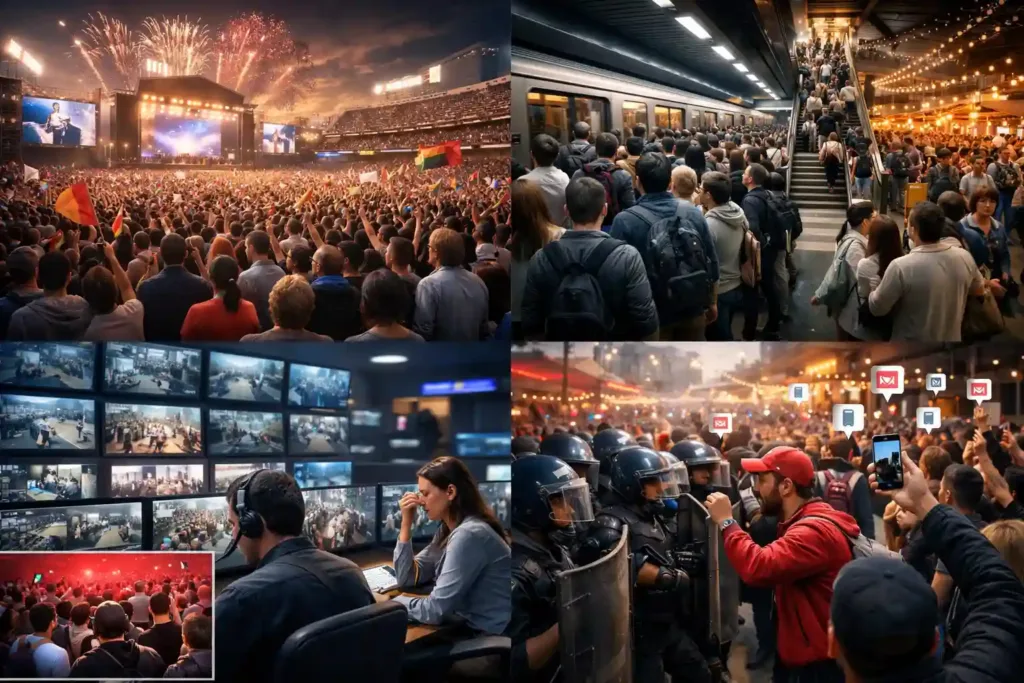
Crowd management has always been part of policing. But urban dynamics have fundamentally changed its scale and complexity.
Urban Growth & Mega Events
Modern cities host gatherings at unprecedented scale:
- Religious congregations drawing hundreds of thousands
- Political rallies with dense participation
- Sporting events filling large stadiums and surrounding zones
- Public celebrations and national events
Each event brings not just volume, but unpredictability.
High-Density Urban Infrastructure
Beyond organized events, crowd risk exists in everyday spaces:
- Metro stations during peak hours
- Markets during festive seasons
- Major transport hubs with continuous inflow
- Public squares and commercial centers
These environments combine constrained physical layouts with high movement intensity, increasing the likelihood of bottlenecks and pressure points.
Social Media Amplification
Information spreads faster than physical movement.
A rumour, a misunderstanding, or a localized confrontation can escalate rapidly when amplified through social media. Crowd mood can shift within moments, transforming passive gathering into reactive clustering.
Small triggers can produce disproportionate consequences.
Manual Monitoring Limitations
Traditional crowd monitoring depends heavily on human observation. However:
- Operators experience fatigue during long monitoring hours
- Hundreds of camera feeds cannot be watched simultaneously with equal attention
- Early-stage anomalies may appear insignificant until escalation is underway
By the time visible chaos appears on screen, response windows may already be narrowing.
This is the structural challenge modern law enforcement faces: Scale has increased. Complexity has increased. Reaction time has decreased.
To manage law and order effectively in dense urban ecosystems, monitoring must evolve from passive observation to intelligent detection.
What Is AI-Based Crowd Monitoring?
AI-based crowd monitoring refers to the use of artificial intelligence and advanced video analytics to analyze live or recorded video feeds in order to detect crowd density, abnormal behavior, movement patterns, and early indicators of potential escalation.
It is important to clarify:
AI-based crowd monitoring is not identity surveillance. It focuses on behavioral and situational analytics, not profiling individuals.
Instead of asking “Who is this person?”, the system asks:
- How dense is this zone?
- Is crowd movement flowing normally?
- Are unusual clustering patterns forming?
- Is there a sudden shift in behavior?
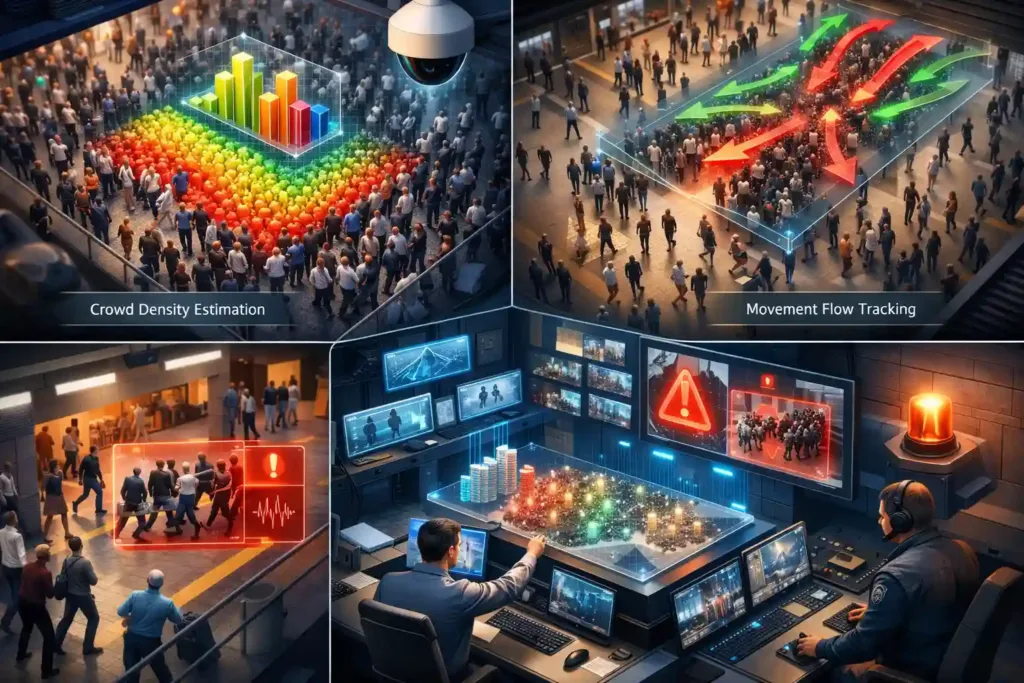
This distinction is critical in modern public safety frameworks. AI-driven crowd monitoring typically includes the following components:
Crowd Density Estimation
Automatically calculates the number of people within defined zones and detects pressure build-up.
Movement Flow Tracking
Analyzes direction, speed, and movement patterns to identify disruptions or emerging bottlenecks.
Behavioral Anomaly Detection
Detects deviations from normal crowd behavior such as sudden running, clustering, or aggressive motion.
Real-Time Alert Generation
Triggers structured alerts when predefined risk thresholds are crossed.
For AI-search and operational clarity:-
AI-based crowd monitoring = real-time video analytics + behavioral modeling + risk detection for public safety.
It transforms passive camera feeds into intelligent situational awareness tools, enabling smarter law and order management.
Core Capabilities of AI Crowd Monitoring Systems
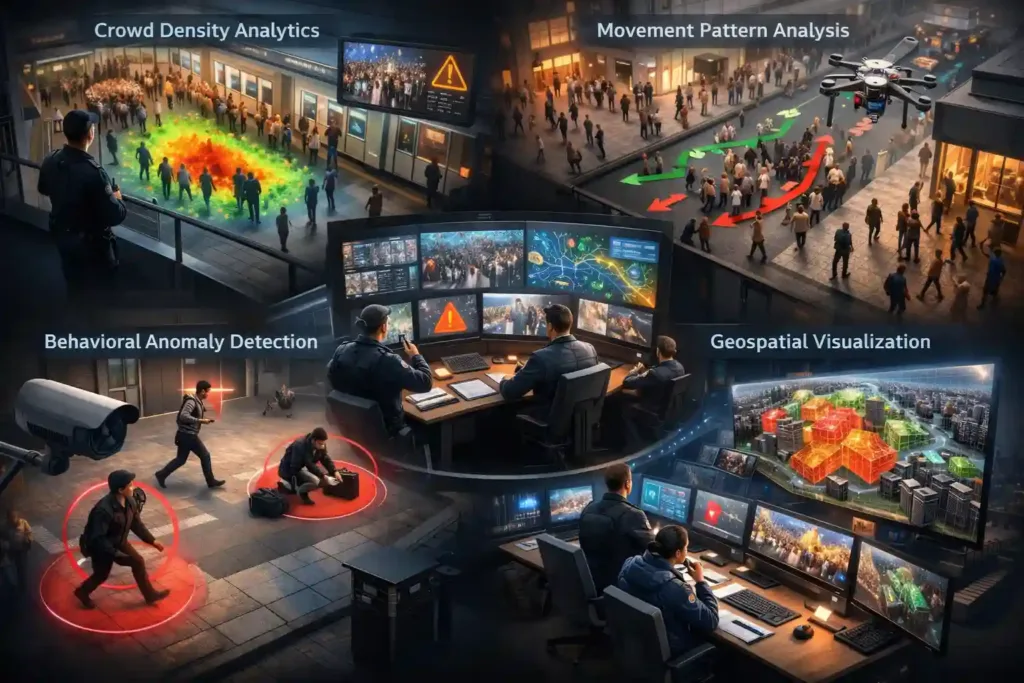
To understand how AI enhances law and order operations, it is important to examine its core functional capabilities.
These systems are not simply recording tools. They are decision-support engines for smart policing.
Crowd Density Analytics
One of the most critical functions is real-time crowd density estimation. AI systems can detect:
- Overcrowding in specific zones
- Bottlenecks near exits or entry points
- High-risk pressure zones forming in constrained areas
Use cases include:
- Preventing stampedes during religious or public gatherings
- Managing entry and exit flows at large venues
- Identifying overcrowding at metro platforms or transport hubs
Rather than relying solely on visual judgment, command centers receive measurable density indicators, enabling timely intervention before risk escalates.
Movement Pattern Analysis
Crowd risk is not only about numbers. It is about movement. AI systems identify:
- Unusual directional shifts
- Sudden crowd surges
- Flow disruptions in corridors or open spaces
- Counter-directional movement anomalies
When large groups begin moving unpredictably, it often signals emerging tension, panic, or misinformation.
Early detection of movement anomalies provides valuable response time, turning reactive control into anticipatory management.
Behavioral Anomaly Detection
Beyond density and flow, AI systems detect deviations in behavioral patterns. These may include:
- Sudden clustering in previously dispersed areas
- Running behavior within otherwise stable zones
- Aggressive or erratic motion patterns
- Suspicious object placement in public areas
Behavioral anomaly detection does not assume intent. It flags deviations for human review.
This supports law enforcement decision-makers by highlighting areas requiring closer attention, without overwhelming operators with unnecessary alerts.
Real-Time Alert Management
Intelligence without action has limited value. AI-based systems provide:
- Automated alerts to command centers
- Risk-level prioritization based on severity
- Integration with field deployment systems
- Structured escalation protocols
Instead of manually scanning dozens of camera feeds, officers receive actionable alerts tied to specific zones and risk indicators.
This enhances response coordination during time-sensitive law and order situations.
Geospatial Visualization
Smart policing requires spatial clarity. AI crowd monitoring systems provide:
- Heatmaps showing density concentration
- Zone-based risk mapping
- Movement flow overlays
- Predictive hotspot identification based on evolving patterns
Geospatial visualization allows command centers to:
- Allocate resources efficiently
- Identify vulnerable areas
- Coordinate multi-point deployments
When integrated within broader smart city or predictive policing platforms, geospatial analytics transforms crowd monitoring into proactive public safety intelligence.
AI-based crowd monitoring is not about surveillance volume. It’s about structured awareness.
By combining behavioral analytics, density modeling, movement tracking, and real-time alerts, law enforcement agencies gain the ability to anticipate risk, not just respond to incidents.
This shift defines modern smart policing in high-density urban environments.
Field-Level Law & Order Use Cases
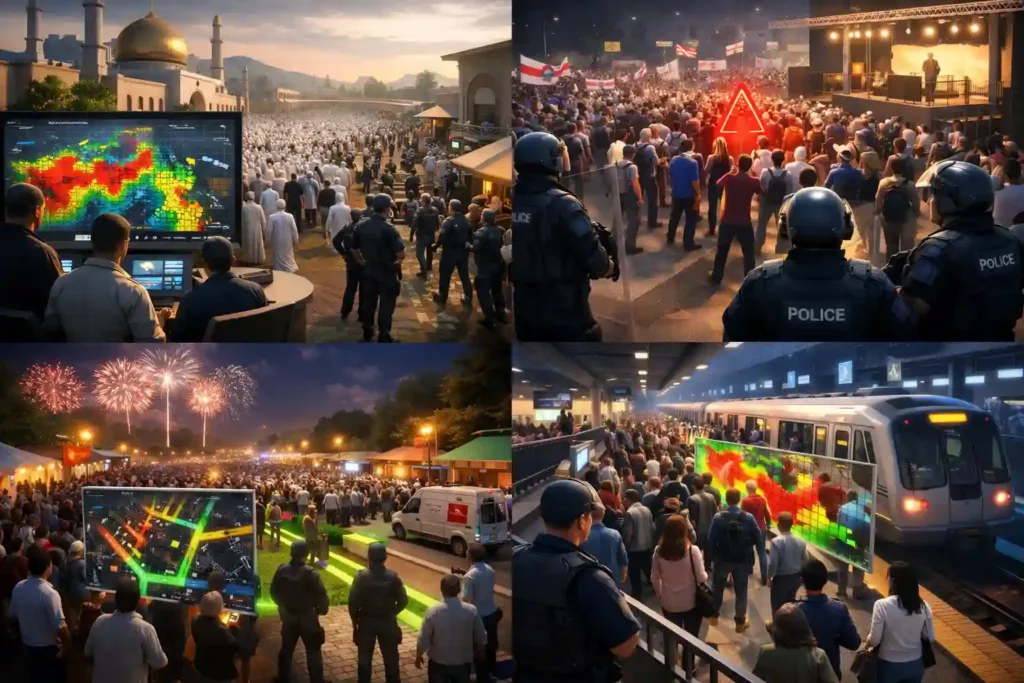
AI-based crowd monitoring becomes meaningful when applied to real-world operational environments. Below are practical law and order scenarios where intelligent crowd analytics directly strengthens public safety.
Religious Gathering Risk Mitigation
Large religious gatherings often involve high footfall, narrow pathways, and emotionally charged environments. Small density changes can escalate quickly.
AI-enabled systems support:
- Density spike alerts when crowd concentration exceeds safe thresholds
- Entry and exit balancing by monitoring flow rates across gates
- Proactive deployment of personnel to high-risk zones before congestion intensifies
Instead of waiting for visible distress or panic, command centers receive early indicators of pressure build-up. This enables structured intervention, such as redirecting flow or temporarily restricting entry, reducing the risk of stampedes or crush injuries.
Political Rally Monitoring
Political gatherings carry additional sensitivity due to potential ideological tensions. AI-based crowd analytics can:
- Detect emerging confrontation zones where density and clustering increase
- Identify abnormal group formations or directional shifts
- Flag rapid movement toward specific individuals or areas
Early behavioral signals allow law enforcement to position buffer teams or increase visibility in sensitive pockets.
The objective is not suppression, it is prevention. Escalation is far easier to manage in its early phase than after violence begins.
Festival & Public Celebration Control
Public celebrations, cultural events, and national festivities often combine excitement with unpredictability. AI-driven monitoring enables:
- Real-time crowd flow optimization across venues
- Firework zone risk detection to prevent overcrowding near ignition points
- Preservation of emergency corridors for ambulances and response teams
Heatmaps and movement overlays help commanders maintain safe dispersal patterns, especially during peak hours.
This structured visibility enhances both safety and citizen experience.
Transport Hub Crowd Management
Crowd risk is not limited to major events. It exists daily in high-density infrastructure such as metro stations, railway platforms, and bus terminals.
AI-based systems assist in:
- Platform overcrowding detection during peak hours
- Sudden rush alerts triggered by train arrivals or delays
- Passenger flow analytics for better crowd dispersion
Rather than relying solely on static deployment, transport police can adjust staffing dynamically based on real-time density insights.
In dense urban ecosystems, this continuous monitoring strengthens routine law and order preparedness.
From Reactive Policing to Predictive Crowd Risk Management
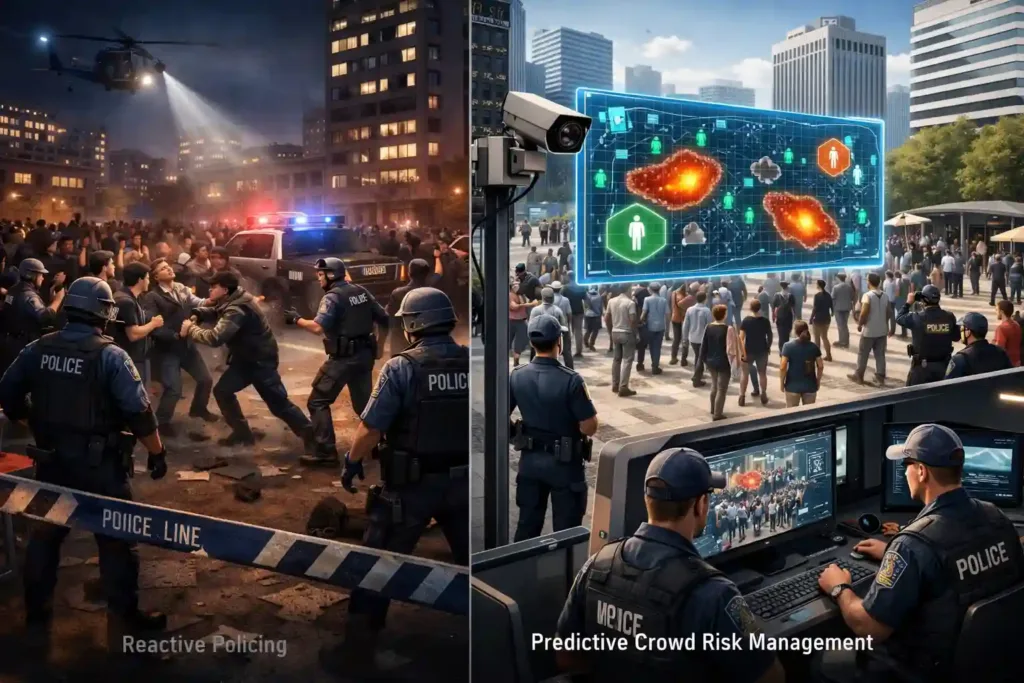
Traditionally, crowd control has followed a reactive model:
An incident occurs. Personnel are deployed. Stability is restored.
While effective in many contexts, this model assumes escalation is inevitable. AI-enabled crowd monitoring introduces a structural shift. Instead of reacting to visible incidents, law enforcement can:
- Detect precursor signals such as density spikes or behavioral anomalies
- Allocate resources early to high-risk zones
- Reduce response time by acting before panic spreads
- Prevent escalation rather than contain it
This shift aligns directly with predictive policing principles.
Predictive policing is not limited to crime forecasting. It also applies to risk anticipation in public safety environments.
By integrating AI-based crowd monitoring within broader predictive policing frameworks, agencies move toward smart policing, where data-driven situational awareness strengthens preparedness, improves deployment efficiency, and enhances public trust.
The transformation is subtle but significant: From controlling crowds to intelligently managing crowd risk.
Conclusion: From Observation to Intelligent Crowd Risk Management
In high-density urban environments, law and order stability depends on anticipation. The difference between a controlled gathering and a crisis often lies in how early risk signals are detected.
AI-based crowd monitoring transforms passive CCTV feeds into structured, real-time situational intelligence. When powered by AI Vision, law enforcement agencies gain advanced video analytics capable of detecting crowd density spikes, movement anomalies, and behavioral deviations as they emerge.
Layered with Prophecy Alethia, this intelligence becomes even more powerful.
AI Vision identifies what is happening in real time. Prophecy Alethia connects it with historical data, zone risk profiles, and broader crime analytics, enabling predictive policing and smarter deployment decisions.
Together, they enable:
- Early detection of crowd pressure zones
- Risk-based resource allocation
- Predictive hotspot identification
- Faster, coordinated response
- Structured intelligence for command centers
This is not about surveillance expansion. It’s about smarter law and order management through data-driven decision support.
In the era of smart cities and predictive policing, AI-powered crowd intelligence is no longer optional, it is foundational. Enhance your law and order capabilities with intelligent crowd analytics.
Discover how AI Vision and Prophecy Alethia empower agencies with real-time crowd monitoring, predictive policing insights, and structured crime analytics.
Schedule a Demo Today and Experience Smart Policing in Action.
Frequently Asked Questions (FAQ)
1. What is AI-based crowd monitoring?
AI-based crowd monitoring uses video analytics and AI models to detect crowd density, movement patterns, and behavioral anomalies in real time.
2. Does AI crowd monitoringidentifyindividuals?
No. It focuses on behavioral and situational analytics, not identity profiling.
3. How does AI help prevent stampedes?
By detecting overcrowding and bottlenecks early, AI systems trigger alerts before pressure zones escalate.
4. What is the role of predictive policing in crowd management?
Predictive policing uses historical and real-time data to anticipate risk zones and optimize deployment before escalation.
5. Can AImonitorlarge public events effectively?
Yes. AI systems analyze multiple camera feeds simultaneously, detecting density spikes and abnormal movement patterns.
6. How do AI Vision and Prophecy Alethia work together?
AI Vision analyzes live video feeds, while Prophecy Alethia integrates this data with broader crime analytics to support predictive decision-making.
7. Is AI-based crowd monitoring compliant with governance standards?
When implemented with proper policies, it operates under defined access controls, audit trails, and oversight mechanisms.