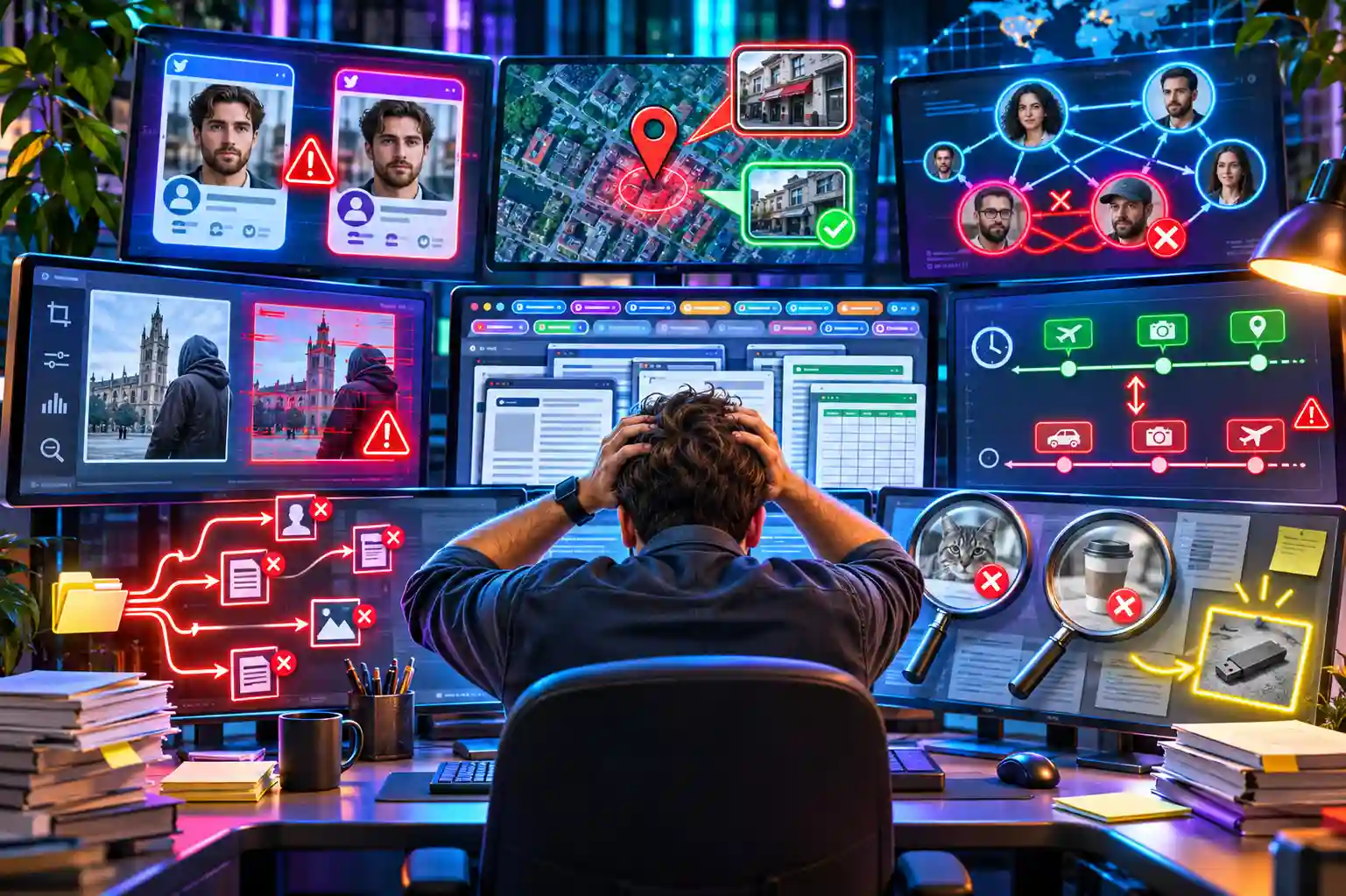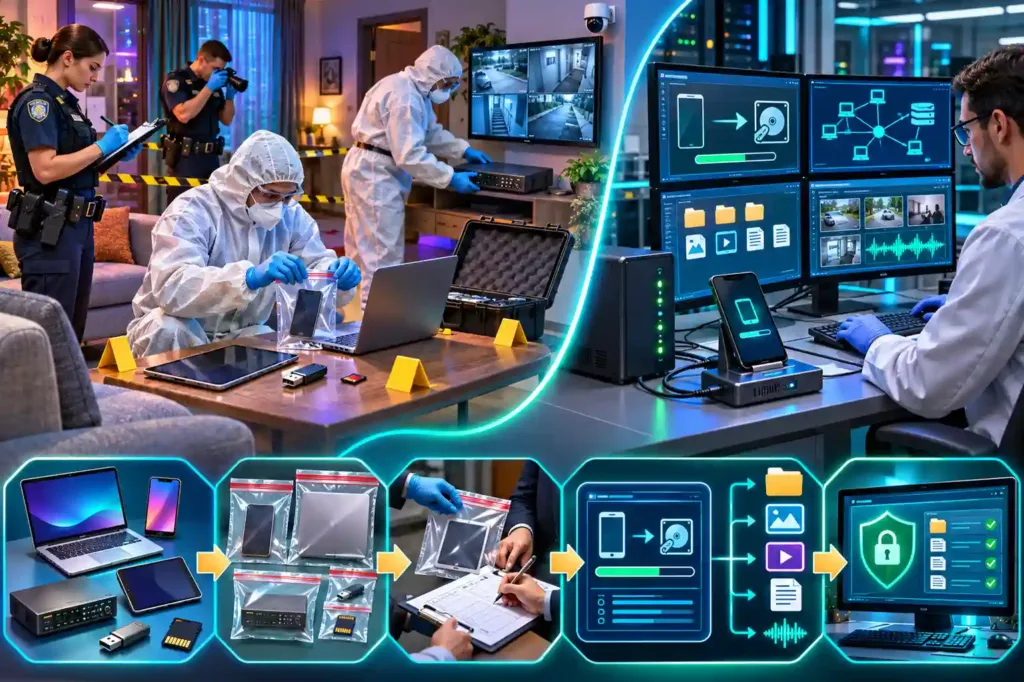
Section 176(3) of the Bharatiya Nagarik Suraksha Sanhita (BNSS) provides that for every offence punishable with imprisonment of seven years or more, the officer in charge ensures that a forensic expert visits the crime scene to collect evidence and that the collection is videographed. Each State notifies the date from which this applies, within five years of the law coming into force on 1 July 2024. The provision raises the standard for physical evidence. Digital evidence, which now features in a growing share of serious cases, carries its own standard under Section 63(4) of the Bharatiya Sakshya Adhiniyam (BSA).
Key Takeaways
- Section 176(3) BNSS covers offences punishable with seven years or more
- A forensic expert visits the scene, and the collection is videographed
- States notify their start date within five years of 1 July 2024
- Cybercrime cases rose about 18 per cent in 2024 while overall crime fell
- Section 63(4) BSA needs a certificate with a hash value and expert certification
- The Supreme Court upheld that requirement in May 2026
- Technology can organise and sort material, while experts and officers decide
- Evidence this sensitive sits best on infrastructure the agency controls
The provision most people skipped

When the BNSS came into force, most of the conversation went to the headline changes: zero FIR, electronic summons, timelines for investigation. Section 176(3) got less attention than it deserved.
Under the earlier code, whether a forensic team reached a scene depended on the investigating officer’s judgement and the district’s resources. Under Section 176(3), it becomes a duty for the most serious cases. Anyone who has worked near investigations understands the logic. Evidence collected by trained people and recorded as it is collected holds up in court better than recollection ever can.
A case, in two versions
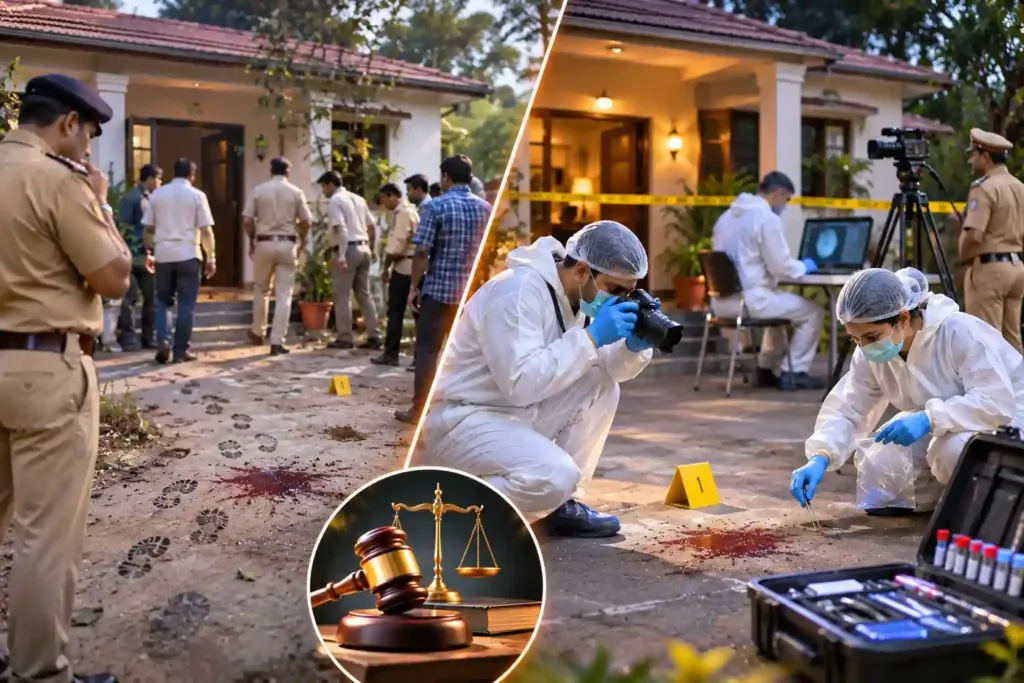
Picture a hypothetical case. A businessman is found deceased at his farmhouse on the edge of a district town. In the first version, the local station reaches the scene within the hour. A forensic team is requested, but the nearest unit is two districts away and arrives the next afternoon. By then, the scene has been walked through by a dozen people.
In the second version, the forensic expert is part of the response from the start. Samples are collected by trained hands, and the camera runs while they work. Months later, when the defence challenges how a stain was lifted, there is footage to answer the question.
That second version is what Section 176(3) is building towards. States have up to five years to notify, which is a sensible runway for a change of this size. The aim is to get the standard right, not to rush it.
India is building the capacity.

The groundwork is visible. The National Forensic Sciences University has been approved for 14 additional campuses, source: PIB. The Home Ministry has offered support for a mobile forensic van in every district. An e-Forensics platform now links 117 central and state laboratories. Capacity like this takes time to build, and it is being built.
The crime scene is only half the picture

Back to our hypothetical case. Within a week, the investigation has produced more than a scene. A phone was seized in one district. A bank statement came from another. There is CCTV footage from a toll plaza, a cloud backup, and months of messages.
This is not unusual anymore. According to the Status of Policing in India Report 2026, drawing on NCRB data, cybercrime cases rose from 86,420 in 2023 to 1,01,928 in 2024. That is an increase of about 18%, in a year when overall registered crime fell by roughly 6%. Digital evidence is becoming the norm, not the exception.
The paperwork behind every phone and every clip

The law has kept pace. Section 63(4) of the BSA requires an electronic record offered as evidence to come with a certificate in the prescribed form. Part A discloses details of the record, including its hash value, which is the digital fingerprint of the file. Part B carries an expert’s certification.
In Pune Bar Association v. Union of India, decided on 22 May 2026, the Supreme Court upheld this requirement. It also clarified that Part B is not limited to examiners notified under Section 79A of the IT Act. Persons with specialised skills in computer science and cyber forensics can certify as well.
In practical terms, every phone extraction and every piece of footage now carries a small trail of paperwork that has to be right for the evidence to count. Multiply that across thousands of cases, and one fact stands out. The standard is high and the volume is large, which is exactly where well-designed technology helps.
Where technology can help in the first hours

Nothing here replaces how investigators work. These are ideas that can sit alongside an agency’s own procedures and training.
At the point of seizure: Analytics can log and hash digital material when it is taken and keep an unbroken record of who handled it afterwards.
In the extraction itself: Tools that understand large extractions can sift through months of messages, call records and images and bring forward what is relevant to the offence. The forensic expert’s time then goes to analysis, not searching.
Across cases: Findings from one case can be matched against others. A number, a vehicle or an account that turns up in three districts can be noticed in one morning.
In the workflow: Guidance can remind an officer of each step a serious case now involves, from videography to certificates, so nothing slips on a busy day.
In the laboratory queue: A clear view of what is pending helps the most serious cases move first.
For the multi-device part of this picture, Innefu’s Argus works as a correlation layer over mobile extraction outputs. It brings material from several devices into one view, so links between a contact, an account and a location are easier to see. It does not extract data, and the findings stay with the investigating officer and the forensic expert to review.
The line technology does not cross.

In every one of these examples, the expert and the investigating officer remain the decision-makers. Technology organises, sorts and remembers. It does not determine guilt, and it is better never built to. That line matters for the courts as much as for the public.
Who holds the evidence?

Forensic evidence is among the most sensitive material any state handles. It sits best on infrastructure the agency controls, with every access recorded and open to review. Systems developed in India and deployed within the agency’s own environment make that easier to guarantee. A reform that strengthens trust in evidence should not weaken control over it.
What this adds up to

The Sanhita sets a demanding standard, and States have the time to meet it well. Standards become habits when the tools make them easy to follow. Getting that part right will do as much for the quality of Indian investigations as the law itself.
Frequently Asked Questions
1. What does Section 176(3) of the BNSS say?
For offences punishable with imprisonment of seven years or more, the officer in charge ensures that a forensic expert visits the crime scene to collect evidence and that the collection is videographed.
2. When does Section 176(3) apply in my State?
Each State notifies the date from which it applies, within five years of the BNSS coming into force on 1 July 2024.
3. Does a forensic visit cover digital evidence too?
The visit addresses evidence at the scene. Electronic records such as phone extractions and CCTV footage follow Section 63(4) of the BSA, which asks for a certificate with a hash value and expert certification.
4. What is a hash value?
It is a digital fingerprint of a file. If even one character in the file changes, the hash value changes, which helps courts check that evidence is unaltered.
5. Did the Supreme Court uphold the Section 63(4) certificate?
Yes. In Pune Bar Association v. Union of India (Writ Petition (Civil) No. 599 of 2026, decided 22 May 2026), the Court upheld the requirement and clarified who can sign Part B.
6. Can AI decide whether someone is guilty?
No. Technology can organise, sort and remember material, while guilt is for courts to decide on evidence.