In June 2026, the Enforcement Directorate arrested a Delhi-based businessman in connection with one of India’s largest narcotics seizures, nearly 3,000 kilograms of heroin intercepted at Gujarat’s Mundra Port in 2021, valued at over ₹20,000 crore in the international market, source: Deccan Chronicle. The ED’s investigation traced how the proceeds moved: shell companies, investments in nightclubs, luxury vehicles registered to benami entities, and, at the centre of it, ₹74 crore transferred through hawala channels to Afghanistan, allegedly to fund terrorist activities.
That ₹74 crore never touched a bank. No transaction record, no wire transfer, no statement line that a compliance officer could flag. It moved through a network of trust-based intermediaries who settle obligations between themselves, often without a single rupee physically crossing the route the money is said to have travelled.
This is the structural challenge hawala presents to anti-money laundering enforcement: it is, by design, invisible to the systems built to detect financial crime. Banks cannot flag a transaction that never happens inside the banking system. The question this raises is direct: if the money trail leaves no trail in the place investigators are trained to look, can AI find a way to see it anyway?
Why Hawala Defeats Conventional Detection

Hawala is not a new phenomenon, and it is not inherently illicit. It is a centuries-old, informal value transfer system, widely used for legitimate remittances in communities where formal banking access is limited or expensive. Its structural characteristics, speed, low cost, minimal documentation, trust-based settlement between hawaladars are exactly what also make it attractive for moving illicit funds.
FATF’s 2024 Mutual Evaluation of India identified hawala and cash couriers as the highest-risk methods for moving illicit funds and other assets within the country, ranked above formal banking channels and money transfer service schemes for this specific function.
The mechanics explain why. A traditional AML system is built to monitor transactions: money entering an account, money leaving an account, the pattern and size of transfers between identifiable parties. Hawala doesn’t generate transactions in this sense. A person in Mumbai gives cash to a hawaladar. The hawaladar contacts a counterpart in Dubai, who pays out an equivalent amount, minus a fee, to the intended recipient. No money physically crosses the border. No bank processes the transfer. The two hawaladars settle their mutual balance later through their own informal mechanisms, sometimes through trade invoicing, sometimes through a separate countervailing flow of funds, sometimes simply as an accumulating ledger entry between trusted parties.
A 2024 research study on hawala detection through graph mining put the core problem precisely: hawala’s adaptability and lack of a paper trail are what hinder law enforcement investigation. There is no fixed typology. The system resists the very category, transaction, that financial monitoring is designed to watch.
Where the Visible Edges Are, And Why That Matters

Hawala is invisible at its core mechanism. But it is not invisible everywhere. The system has to interface with the formal economy at specific points, and those points leave traces, fragmentary, indirect, and individually unremarkable, but traces nonetheless.
Cash movement that doesn’t match declared income or business activity
Hawaladars and their associates handle large cash volumes that have to originate and terminate somewhere. Unusual cash deposit and withdrawal patterns, inconsistent with the declared business of the account holder, are one of the only points where hawala activity brushes against the formal banking system.
Trade-based settlement
When hawaladars settle their mutual balances, they frequently use trade invoicing, over-invoicing or under-invoicing goods shipments between entities they control, to move value across borders in a way that looks like ordinary commerce. This is documented by FATF as one of the primary channels through which hawala networks reconcile their internal accounts.
Communication patterns
Hawala operates on relationships and trust. Coordinating a transfer requires communication between the originating and receiving hawaladars, phone calls, messages, sometimes simple coded references. This communication leaves a trace in telecom data even when the financial transaction itself does not.
Property and asset acquisition with no clear funding source
When hawala-laundered funds are eventually integrated into the legitimate economy, as the ED’s investigation into Dubai property holdings funded through hawala channels demonstrated, the acquisition itself becomes a visible, documentable event, even though the path the money took to get there remains obscured.
None of these signals, on their own, proves anything. A single unusual cash deposit is just that. A single property purchase with unclear funding could have a dozen innocent explanations. The investigative value is not in any one signal. It is in the pattern that emerges when these fragmentary signals are analysed together, across a large enough dataset, by a method built to find structure rather than individual anomalies.
This is precisely the kind of problem graph-based AI analysis is built to solve.
How AI Approaches the Hawala Detection Problem

Graph Neural Networks: Modelling Relationships, Not Just Transactions
The most significant advance in AI-powered financial crime detection over the past several years has been the application of Graph Neural Networks (GNNs) to transaction and relationship data. Unlike traditional rule-based systems, which evaluate each transaction in isolation against fixed thresholds, GNNs model the entire network of relationships between entities, accounts, individuals, businesses, and properties and learn to recognise structural patterns that indicate suspicious activity.
Academic research applying graph mining specifically to hawala detection has identified what researchers term “black hole transaction patterns”, structural signatures in financial and relationship data that are consistent with how hawala networks settle and obscure value transfer, even when no single transaction in the dataset is itself flagged as suspicious. The research explicitly frames this capability as a complement to existing bank compliance systems, not a replacement, a tool that extends what banks can already see into the patterns that emerge only when fragmentary signals are connected at scale.
Recent peer-reviewed work in this space has demonstrated meaningful real-world performance: one 2025 study applying reinforcement learning combined with graph neural networks to financial fraud detection reported a 19.7% improvement in detection recall and a 33% reduction in false positives compared to standard graph-based baseline models, with near real-time inference. This matters specifically for hawala-adjacent detection, where the volume of legitimate cash-intensive businesses and ordinary cross-border remittance makes false positives a genuine operational cost, flagging too aggressively buries investigators in noise, while flagging too conservatively misses the network entirely.
Multi-Source Pattern Correlation
A single data source, banking transactions alone, or CDR data alone or property records alone, is rarely sufficient to surface a hawala network. The signal exists in the correlation across sources.
An AI-driven investigative approach can simultaneously process banking transaction anomalies, trade invoicing irregularities, communication pattern data, and asset acquisition records, identifying where these independently weak signals converge around the same individuals or entities. A cash-intensive business with trade invoicing patterns inconsistent with its declared trade, communication contact with individuals previously associated with flagged hawala activity, and recent high-value asset acquisition with no clear funding source is a meaningfully different risk profile than any one of those signals alone, and that composite risk profile is exactly what multi-source AI correlation is designed to surface.
Entity Network Mapping Across the Visible Fragments
Where hawala networks intersect with the formal economy, through front businesses, trade entities, or individuals who interface between the informal system and documented channels, AI-powered entity relationship mapping can construct a network graph from the available fragments, even when the core financial mechanism remains undocumented.
This is the same underlying capability that applies to shell company network detection: mapping connections between entities, flagging structural patterns consistent with known typologies, and surfacing the network rather than requiring investigators to manually connect isolated data points across banking records, trade documentation, and communication intelligence.
Continuous Monitoring for Emerging Patterns
Hawala networks adapt. As enforcement identifies and disrupts one channel, operators shift to new fronts, new trade patterns, new communication methods. Static rule sets calibrated against historical typologies fall behind as the network evolves.
AI systems trained on pattern recognition rather than fixed rules can identify structural similarities to known hawala typologies even when the specific entities, amounts, and routes are new, continuously monitoring for the emergence of patterns consistent with hawala activity rather than waiting for a rule update to catch up with an adapted network.
The Sovereign Deployment Requirement
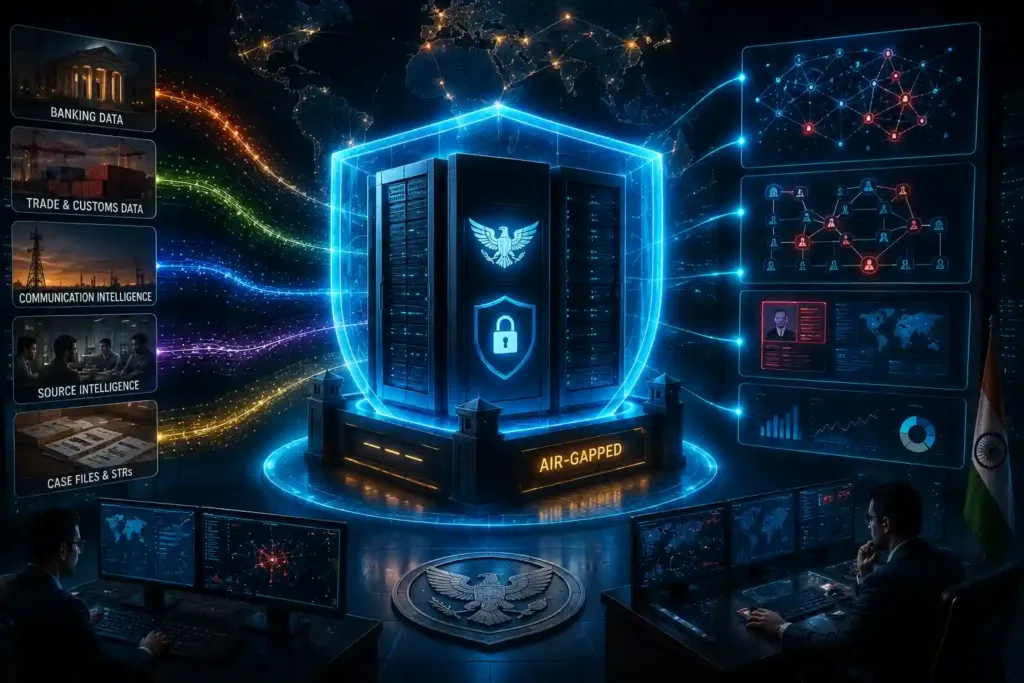
Hawala investigation data, STRs, communication intelligence, ongoing case files, source intelligence on suspected networks, is among the most sensitive financial intelligence an agency holds. It often intersects with active counter-terrorism financing investigations, as the Mundra Port case demonstrates. Any AI system applied to this data must operate entirely within the deploying agency’s secure infrastructure, with no external data calls and no telemetry.
Prophecy Eagle I, Innefu Labs’ sovereign Financial Intelligence Fusion Platform, is built for exactly this kind of multi-source financial investigation, capable of correlating transaction data, communication intelligence, and entity relationships simultaneously, fully on-premise and air-gapped, with no data leaving the deploying organisation’s boundary at any point in the analysis.
To Conclude

Banks cannot see what never enters the banking system. That is not a flaw in bank compliance, it is the defining design feature of hawala, and it is precisely why the system has remained one of the highest-risk channels for moving illicit funds in and out of India for decades.
AI does not solve this by seeing the invisible transaction. It solves it by getting better at seeing everything around it, the cash patterns, the trade settlements, the communication traces, the asset acquisitions, and connecting fragments that, taken individually, never rise to the level of suspicion but together form a structure no rule-based system was built to recognise.
The ₹74 crore that moved silently from Mumbai to Afghanistan in the Mundra Port case was eventually traced, but only after the broader narcotics investigation surfaced it. The harder question, the one AI-powered graph analysis is specifically built to address, is whether that kind of network can be surfaced earlier, from the fragments it leaves behind, before the investigation that exposes it has to start somewhere else entirely.
Frequently Asked Questions
1. Why is hawala so difficult to detect compared to other money laundering methods?
Hawala operates through trust-based settlement between informal intermediaries (hawaladars), without the underlying funds physically crossing the route the transfer is associated with. Because no transaction is recorded at the point of transfer, conventional AML systems, which monitor transactions for suspicious patterns, have nothing to flag at the core of the mechanism. Detection depends instead on identifying indirect signals at the points where hawala networks interface with the formal economy, such as cash flows, trade settlement, and asset acquisition.
2. Can AI actually detect hawala transactions directly?
No, and it’s important to be precise about this. AI cannot observe a hawala transaction directly, because the transaction itself generates no data in any system AI can access. What AI can do is identify and correlate the fragmentary, indirect signals that hawala networks leave at their points of contact with the formal economy, unusual cash patterns, trade invoicing irregularities, communication data, and asset acquisition records, and surface the composite pattern that justifies investigation. This is network footprint detection, not direct transaction monitoring.
3. What is a Graph Neural Network and why is it used for hawala and money laundering detection?
A Graph Neural Network (GNN) is a type of AI model designed to analyse relationships between entities, accounts, individuals, businesses, rather than evaluating each data point in isolation. For hawala and money laundering detection, this matters because the suspicious signal is rarely in any single transaction; it’s in the structure of relationships and patterns across many entities and data points. GNNs can learn to recognise structural patterns consistent with known laundering typologies, including patterns researchers have termed “black hole” structures associated with hawala-style value transfer, even when individual transactions appear unremarkable.
4. Why are false positives a particular challenge in hawala-adjacent detection?
Cash-intensive legitimate businesses, ordinary cross-border remittances, and routine trade activity can superficially resemble some of the indirect signals associated with hawala activity. Flagging too aggressively floods investigators with false leads and reduces operational efficiency; flagging too conservatively misses genuine networks. Modern graph-based AI approaches, particularly those combining graph neural networks with reinforcement learning, have demonstrated meaningful improvements in this trade-off, with recent research reporting double-digit gains in detection recall alongside significant reductions in false positive rates compared to earlier-generation models.
5. How does hawala connect to terrorism financing in India?
FATF’s 2024 Mutual Evaluation of India identified hawala and cash couriers as the highest-risk channels for moving funds associated with terrorism financing within the country. Documented enforcement cases, including the Mundra Port heroin case, where the Enforcement Directorate traced ₹74 crore moved through hawala channels to Afghanistan for alleged terrorist financing, illustrate this connection directly. This is one of the reasons hawala detection sits at the intersection of financial intelligence and national security investigation rather than being treated as a purely financial compliance matter.
6. Is AI currently deployed for hawala detection by Indian enforcement agencies?
AI-powered graph analysis for hawala and related financial crime detection is an emerging capability, with strong academic and research foundations, that is being evaluated for operational deployment rather than in widespread use across Indian enforcement agencies today. The underlying methodology, graph neural networks applied to multi-source financial and relationship data, is well-established in peer-reviewed research and is increasingly available in purpose-built platforms designed for sovereign, on-premise deployment that meet the data sensitivity requirements of financial intelligence work.