Forty-seven individuals walk into branches of three different banks across a mid-sized Indian city over the course of 30 days. Each one makes a cash deposit. Each deposit is between ₹45,000 and ₹49,500. No single transaction crosses the ₹50,000 threshold that would require additional documentation. No individual visits the same branch twice in a week. None of them are on any watchlist.
On paper, nothing happened.
In reality, ₹2.1 crore in illicit funds just entered the formal financial system: clean, undetected, and ready for the next stage of laundering.
This is smurfing. And it is one of the most persistently effective money laundering techniques precisely because it is designed to be invisible to conventional detection systems.
What is Smurfing, And Why the Name?

Smurfing, formally known as structuring, is a money laundering technique where large sums of illicit cash are broken into multiple smaller transactions, each deliberately kept below the reporting thresholds that would trigger regulatory scrutiny.
The name comes from the idea of many small agents, “smurfs”, each carrying a small piece of the total, so that no single piece looks significant. In practice, these agents are often money mules: individuals recruited, coerced, or paid to conduct transactions on behalf of the criminal network, typically unaware of the full picture.
The core logic is simple and brutally effective: financial monitoring systems are largely built around thresholds. Stay below the threshold, stay invisible.
In India, cash transactions above ₹10 lakh in a single day from a single account trigger reporting obligations under PMLA (Prevention of Money Laundering Act). Transactions above ₹50,000 require PAN details. Smurfs are briefed on exactly these thresholds, and instructed to stay well below them, across multiple accounts, multiple branches, and multiple days.
The Three Layers Smurfing Operates Across

To understand why smurfing is so difficult to detect, it helps to understand where it sits in the broader money laundering process.
Money laundering typically operates across three stages: placement, layering, and integration.
Placement is where dirty cash enters the financial system. This is the highest-risk stage for criminals, cash is physical, traceable, and conspicuous in large volumes. Smurfing is primarily a placement technique, used to deposit illicit cash in amounts small enough to avoid detection.
Layering is where the trail gets deliberately complicated. Funds move between accounts, entities, geographies, and instruments, sometimes dozens of times, to obscure their origin. Smurfing networks often have a layering component too: once funds are deposited across multiple accounts, they are consolidated and moved again through a chain of transfers.
Integration is where the laundered funds re-enter the legitimate economy, as property purchases, business investments, luxury assets, or loan repayments that create a clean paper trail.
The reason smurfing is particularly dangerous is that it undermines detection at the very first stage. Once cash clears placement successfully, each subsequent layer adds distance from the origin and makes eventual recovery exponentially harder.
Why Rule-Based Systems Fail at Smurfing Detection

Most legacy AML systems, and many that are still in use today, operate on rule-based logic. A transaction above threshold X triggers a flag. A customer making more than Y transactions in Z days gets reviewed. An account receiving funds from a high-risk geography generates an alert.
These rules are not useless. They catch basic violations and obvious patterns. But against a well-organised smurfing network, they are fundamentally inadequate for three reasons.
First, they are threshold-dependent. Smurfing is explicitly designed to defeat thresholds. A criminal network briefed on your reporting limits will operate just below them, consistently, across every participant. Rule-based systems flag the threshold; they do not flag the deliberate, coordinated behaviour of staying just beneath it.
Second, they are account-level. Traditional monitoring looks at individual accounts. A smurfing network distributes activity across dozens or hundreds of accounts. No single account shows unusual behaviour. The pattern only becomes visible when you analyse relationships and behaviour across the entire network simultaneously, something rule-based systems were not designed to do.
Third, they generate overwhelming false positives. The more rules you add to compensate for the above gaps, the more legitimate transactions get flagged. Compliance teams end up drowning in alerts, the majority of which lead nowhere. Genuine smurfing patterns get buried in the noise.
This is not a theoretical problem. Financial institutions globally file millions of Suspicious Transaction Reports annually, and a significant proportion are driven by rule-based systems triggering on legitimate behaviour rather than genuine structuring networks. The signal-to-noise ratio is poor, and smurfs know it.
What AI-Based Detection Actually Changes

AI-powered AML transaction monitoring doesn’t just lower thresholds or add more rules. It changes the nature of detection entirely.
Here is what it does differently:
Behavioural pattern recognition across the network
Instead of evaluating transactions account by account, AI models analyse behaviour across connected entities simultaneously. Forty-seven deposits of ₹49,000 across 47 different accounts look unremarkable in isolation. Analysed together, same time window, same geographic cluster, same destination accounts after consolidation, the pattern becomes statistically unmistakable.
Structuring detection without fixed thresholds
Machine learning models trained on historical smurfing cases learn to recognise the behavioural signatures of structuring, not just the dollar amounts. Consistent deposit amounts just below reporting limits, coordinated timing across multiple accounts, unusual geographic spread followed by rapid consolidation: these are detectable patterns regardless of the absolute transaction values involved.
Money mule identification
A mule account has a distinctive profile: it receives funds from multiple sources it has no prior relationship with, holds the balance briefly, then transfers it out in a pattern inconsistent with normal retail or business banking behaviour. AI models can flag these accounts proactively, before the funds are moved further, rather than reactively after the damage is done.
Multi-hop transaction tracking
Smurfing networks rarely stop at one deposit. Funds deposited across multiple accounts are typically consolidated and then layered further, through shell companies, multiple bank hops, property purchases, or cross-border transfers. AI platforms that model the entire transaction graph, tracking funds through multiple intermediaries over time, can surface the final destination of funds even when the trail spans dozens of hops.
Cyclical transaction detection
One of the signatures of sophisticated laundering networks is cyclical fund flows, money that appears to circulate between entities, creating the appearance of legitimate business activity while actually obfuscating origin. AI systems that monitor for recurring transaction cycles across entity networks can flag these patterns in ways that rule-based systems simply cannot.
Reduced false positives through risk scoring
Rather than binary flag/no-flag decisions, AI-powered systems assign dynamic risk scores to accounts and transactions based on the full context of their behaviour. This means compliance teams focus investigation effort on genuinely high-risk cases, not on the retired schoolteacher who made three cash deposits in a fortnight.
The Indian Context: Why This Matters Urgently
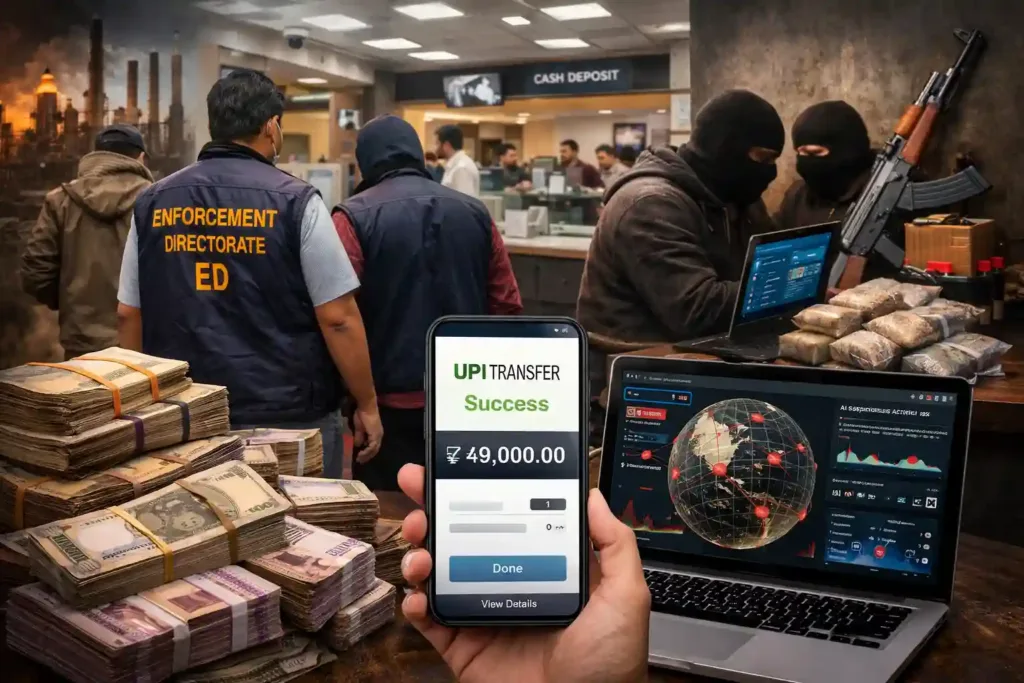
India’s AML compliance landscape has strengthened considerably in recent years. PMLA enforcement has expanded. FIU-IND’s reporting requirements have tightened. The FATF mutual evaluation in 2023 brought significant attention to gaps in beneficial ownership transparency and the effectiveness of suspicious transaction reporting.
But the scale of the challenge is daunting. India’s banking system spans thousands of branches, hundreds of millions of accounts, and transaction volumes that make manual review effectively impossible at any meaningful depth. The informal cash economy creates persistent placement risk. And criminal networks, particularly those linked to narcotics trafficking, terror financing, and organised fraud, have demonstrated consistent sophistication in adapting their methods to evade detection systems.
Smurfing networks in India have evolved considerably. Modern operations use jan dhan accounts, dormant accounts reactivated by intermediaries, and coordinated UPI transactions, not just cash deposits, to achieve the same structuring effect. The threshold-avoidance logic is the same; the channels have diversified.
Rule-based systems built for an earlier era of banking are not equipped for this. AI-powered financial intelligence platforms are not a luxury upgrade, they are the infrastructure gap that serious AML enforcement requires.
Prophecy Eagle I: Built for Financial Crime Detection at Scale

Innefu’s Prophecy Eagle I is a big data analytics platform designed specifically for financial fraud detection and revenue intelligence, including the kind of complex, multi-entity, multi-transaction patterns that characterise smurfing networks.
Its capabilities map directly to the detection challenges described above:
Network analysis across multiple datasets
Prophecy Eagle I ingests bank statements, GST transaction data, company registration databases, the Vaahan database, property ownership records, and more, correlating them into a unified data lake. This means smurfing patterns that span multiple accounts, entities, and asset classes can be detected as a network phenomenon, not just as isolated transactions.
Cyclical transaction identification
The system automatically identifies recurring financial transaction patterns and flags unusual cycles, including the kind of circular fund flows used to simulate legitimate business activity while layering illicit funds.
Multi-hop transaction tracking
Prophecy Eagle I tracks financial transactions through multiple intermediaries to uncover hidden links, following the money through the full chain of layering, not just the first deposit.
Mule account detection through image analytics
The platform builds facial libraries of financial absconders and cross-checks new account applications against them, flagging duplicate identity documents used to create multiple accounts, a standard technique for expanding smurfing capacity.
Automated risk scoring and alerts
Entities are segmented and clustered based on income sources, transaction patterns, net worth, activity timelines, and behavioural anomalies. Risk scores are assigned dynamically, and automated alerts flag suspicious patterns for investigator attention, reducing the noise that buries genuine signals in rule-based systems.
360-degree suspect profiling
When a smurfing network is identified, Prophecy Eagle I builds comprehensive profiles of all connected entities, their associations, transaction histories, asset holdings, and behavioural timelines, giving investigators a complete picture rather than a fragment.
Critically, the platform operates with no connection to the internet. All AI models run on-premise, within the institution’s own infrastructure. Data never leaves the controlled environment, essential for financial institutions handling sensitive customer and transaction data under regulatory obligations.
What Compliance Teams Should Be Asking

If you are responsible for AML compliance, financial crime investigation, or fraud risk in a banking or financial intelligence context, the right questions to be asking about your current detection infrastructure are:
Does your system detect structuring behaviour, not just threshold breaches? Can it identify coordinated patterns across accounts with no prior relationship to each other? Does it model transaction networks, or evaluate accounts in isolation? How does it perform on UPI and digital payment channels, not just traditional banking transactions? What is the false positive rate, and what is the cost of that noise on your investigation team’s capacity?
The answers will tell you whether your current system would have caught those 47 deposits.
Smurfing persists not because it is clever. It persists because the systems built to catch it were designed for a simpler era of financial crime. The criminal networks running these operations understand your detection infrastructure, often better than the institutions themselves.
Closing that gap requires more than tighter rules. It requires the ability to see what rule-based systems structurally cannot: the pattern across the network, the behaviour beneath the threshold, the mule account before it consolidates, the cycle before it completes.
That is what AI-powered financial crime detection is built to do.