
Patrol Planning is Where Strategy Meets Reality
Patrol planning is where policing strategy translates into on-ground action. It determines who goes where, when, and with what priority, often under conditions of uncertainty and constraint.
Traditionally, patrol planning has been shaped by:
- Fixed beats that rarely change
- Historical averages that reflect the past, not emerging risks
- Manual intuition, experience-driven but difficult to scale or validate
However, modern policing operates in a very different environment. Law enforcement agencies today must manage:
- Limited manpower and finite operational resources
- Increasing urban density and population mobility
- Rapidly shifting crime patterns influenced by time, location, and context
In this reality, static patrol schedules struggle to keep pace. Predictive policing shifts patrol planning from fixed routines to intelligence-led deployment, where patrol decisions are informed by data-driven insights that help anticipate crime patterns rather than merely respond to them.

Key Takeaways
- Patrol planning is where predictive policing delivers immediate operational impact.
- Risk-based insights help move patrols from reactive response to proactive presence.
- Dynamic scheduling allows patrol plans to adapt to time, location, and changing conditions.
- Smarter resource allocation improves efficiency across patrol, vehicle, and specialised units.
- Intelligence-backed deployment enhances officer confidence and operational readiness.
The Limitations of Traditional Patrol Allocation Models
Conventional patrol allocation models were designed for a more predictable operating environment. As crime patterns become increasingly dynamic, these models reveal several operational limitations.
One of the most significant challenges is reactive deployment. Patrols are often intensified only after incidents occur, limiting the ability to prevent crimes before they escalate. This approach can leave agencies perpetually one step behind emerging threats.
Traditional models also tend to result in over-patrolling low-risk areas while under-covering emerging hotspots. When patrol routes are fixed or based on outdated trends, resources are not always aligned with current risk levels.

Over time, this misalignment contributes to resource fatigue and uneven workload distribution. Some units face sustained operational pressure, while others remain underutilised, affecting both efficiency and officer morale.
Additionally, static patrol plans are difficult to adjust in real time. Sudden changes, such as local events, seasonal shifts, or evolving crime behaviour, often require manual intervention, slowing response and reducing agility.
Together, these limitations highlight the need for a more adaptive approach to patrol planning, one that supports proactive decision-making without adding operational complexity.
How Predictive Insights Inform Patrol Planning
Predictive insights are valuable only when they translate into clear, actionable patrol decisions. In patrol planning, this means converting diverse data points into practical deployment signals that commanders and operations teams can act on with confidence.
Rather than focusing on how predictions are generated, the emphasis is on how those insights guide where, when, and how patrol resources are deployed.
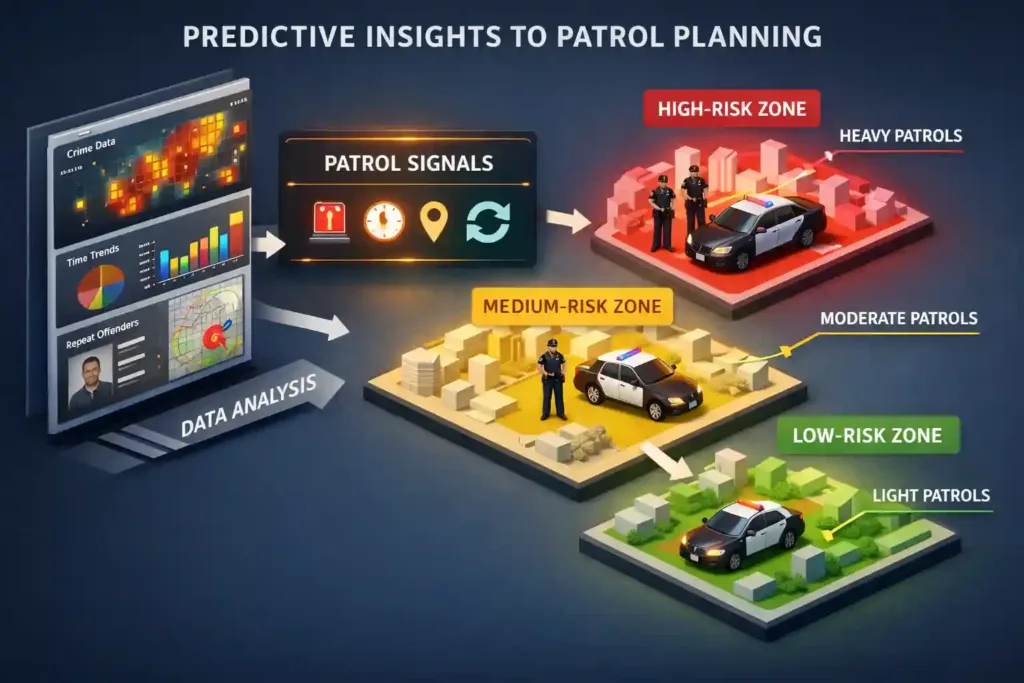
From Crime Data to Patrol Signals
Patrol planning begins with consolidating multiple sources of operational data into a unified view of risk.
Key inputs typically include:
- Incident data, highlighting the type, frequency, and severity of reported crimes
- Temporal trends, such as time-of-day and day-of-week patterns that indicate when specific offences are more likely to occur
- Location-based risk indicators, identifying areas with recurring or escalating activity
- Repeat offender and repeat location signals, which help distinguish isolated incidents from persistent patterns
When viewed together, these elements move beyond raw statistics. They form patrol signals, clear indicators that suggest where focused presence, visibility, or monitoring may be required during specific time windows.
This shift allows patrol planning to reflect current and emerging conditions, rather than relying solely on historical averages.
Turning Risk Scores into Patrol Decisions
Once risk levels are identified, the next step is aligning patrol resources accordingly. Effective patrol planning uses risk differentiation to guide deployment intensity, ensuring resources are applied where they can have the greatest preventive impact.
A common operational approach includes:
- High-risk zones → Increased patrol visibility through more frequent coverage, extended presence, or overlapping patrol routes
- Medium-risk zones → Intermittent coverage designed to maintain deterrence without over-allocating resources
- Low-risk zones → Optimised minimal deployment, maintaining baseline presence while freeing resources for higher-priority areas
This structured allocation enables law enforcement teams to balance deterrence, coverage, and efficiency. Patrols become purposeful rather than routine, and deployment decisions are easier to justify, adjust, and communicate across command levels.
By grounding patrol planning in actionable predictive insights, agencies move closer to proactive policing, without adding complexity to day-to-day operations.
Dynamic Patrol Scheduling: Moving Beyond Fixed Beats

Traditional patrol schedules are often built around fixed beats and predefined routes. While predictable, these structures leave little room to respond to changing conditions on the ground. Predictive-led patrol planning introduces a more adaptive approach, one that evolves with risk patterns rather than remaining locked to static assignments.
With predictive insights, patrol scheduling can be adjusted shift by shift, reflecting how risk levels vary across different times of day and days of the week. Areas that require heightened attention during night shifts, for example, may not need the same level of coverage during daytime hours.
Patrol intensity can also be tailored at an area-specific level. Instead of applying uniform coverage across a jurisdiction, resources are distributed based on localized risk signals, ensuring attention is proportional to need.
Another advantage lies in seasonal and event-based adjustments. Festivals, public gatherings, weather changes, or recurring seasonal trends often influence crime patterns. Dynamic scheduling allows patrol plans to account for these variables in advance, rather than reacting after incidents occur.
As conditions evolve, patrol routes and deployment patterns can be modified accordingly. In this model, patrol plans are no longer static documents, they become living deployment strategies, capable of adapting to real-world changes without disrupting operational continuity.
Optimising Resource Allocation Across Units
Effective resource allocation extends beyond deciding where patrols are sent. It also involves determining which types of resources are most appropriate for specific operational needs.

Predictive insights support more informed allocation across:
- Foot patrols, suited for visibility and community engagement in dense or sensitive areas
- Vehicle patrols, enabling rapid coverage across larger zones or response corridors
- Specialised units, deployed selectively for higher-risk or more complex scenarios
By matching the resource type to the predicted threat level, agencies can avoid over-deploying high-value or specialised assets where they are not required. This ensures critical capabilities remain available for situations where they are most effective.
Improved allocation also strengthens coordination between central command and field units. Clear, intelligence-backed deployment plans help align strategic priorities with on-ground execution, reducing ambiguity and improving operational cohesion.
Improving Officer Efficiency and Operational Readiness
Beyond operational efficiency, predictive-led patrol planning has a direct impact on the people executing these plans. Officers benefit from deployments that are purposeful rather than random.
With clearer risk-based guidance, patrols are no longer assigned without context. This leads to reduced random patrolling and more focused presence in areas that genuinely require attention.
Clearer patrol objectives also contribute to better workload balance. When deployment decisions are aligned with real-time risk, resources are distributed more evenly, helping prevent prolonged strain on specific teams or units.

Over time, this approach supports lower fatigue and reduced burnout, as officers spend less time on low-impact deployments and more time on meaningful preventive activity.
Perhaps most importantly, intelligence-backed decisions foster higher officer confidence. When patrol plans are supported by data-driven insights, officers understand the rationale behind their assignments: strengthening trust, readiness, and overall operational effectiveness.
To Conclude: From Patrol Coverage to Proactive Policing
Patrol planning is one of the most visible and operationally critical aspects of policing. When driven by static schedules and historical averages, it often struggles to keep pace with evolving risks and resource constraints.
Predictive-led patrol planning enables law enforcement agencies to move from routine coverage to purposeful, intelligence-informed deployment. By aligning patrol schedules, resource allocation, and officer effort with emerging risk patterns, agencies can improve efficiency without adding complexity to daily operations.
Importantly, this shift does not replace professional judgement, it strengthens it. Patrol decisions become clearer, more adaptable, and easier to justify across command levels. As a result, predictive policing delivers some of its earliest and most tangible value through smarter patrol planning, laying the foundation for broader intelligence-led policing strategies.
FAQs – Frequently Asked Questions
How does predictive policing support patrol planning?
Predictive policing supports patrol planning by identifying risk patterns across time and location, allowing agencies to deploy patrols more strategically and proactively.
Does predictive-led patrol planning replace traditional patrol methods?
No. It enhances traditional patrol methods by providing additional context and insights, helping commanders adjust deployment without eliminating existing practices.
Can predictive insights help optimise limited police resources?
Yes. By aligning patrol intensity and resource types with risk levels, agencies can avoid over-deployment and make more efficient use of available manpower.
How often can patrol plans be adjusted using predictive insights?
Patrol plans can be updated shift-wise or as conditions change, enabling more flexible and responsive deployment compared to fixed schedules.
Is predictive patrol planning applicable to both urban and semi-urban areas?
Yes. Predictive-led patrol planning can be adapted to different geographies, provided relevant incident and operational data is available.